
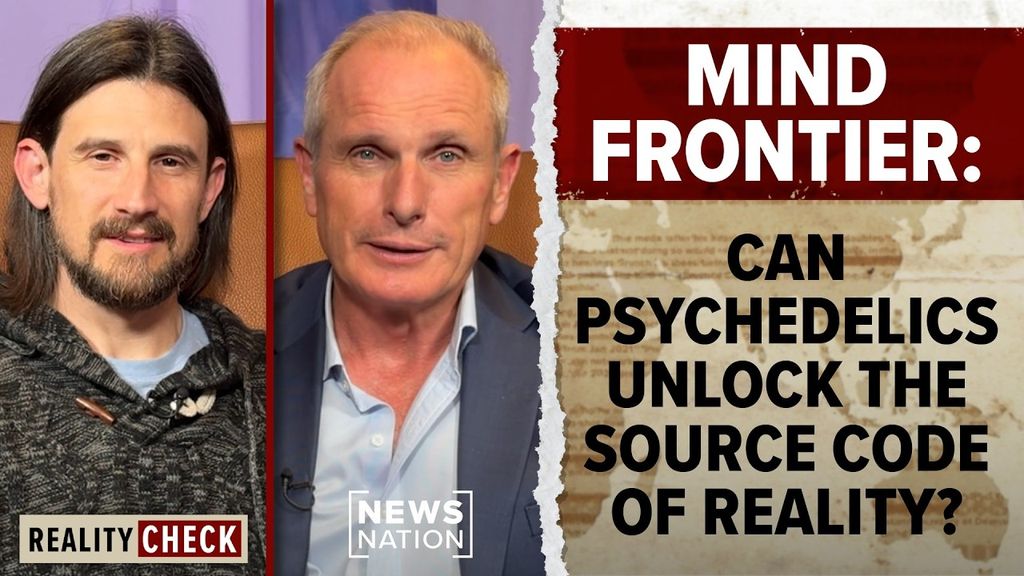
Researcher Claims DMT-Laser Setup Reveals Structured Symbolic “Code,” Stirring Debate Over Consciousness, Optics, and Science Standards


A growing debate at the intersection of neuroscience, optics, and consciousness research is testing the boundaries of what counts as measurable reality. Researcher Danny Goler asserts that a simple, low-powered, diffracted red laser—observed while under the influence of DMT—reveals a highly structured, glyph-like pattern that appears consistent across individuals. He interprets this pattern as a kind of symbolic substrate, potentially revealing the mechanism by which the brain encodes perceptual content. His claim challenges the prevailing view that psychedelic visuals are idiosyncratic hallucinations and raises questions about reproducibility, instrumentation, and the appropriate standards for evidence in consciousness studies.
Scientific viability and testability remain central. The orthodox account holds that DMT’s binding to serotonin receptors (notably 5-HT2A) induces geometric visuals and entity-like perceptions, while a laser pattern could foster pareidolia—particularly given the known physics of speckle, diffraction, and laser-induced optical artifacts. Skeptics also point to demonstrations of laser-induced plasma filaments in air as examples of structured light producing striking, variable patterns without invoking novel physics. Goler counters that many observers report seeing substantially similar symbols in the diffracted band, arguing that this cross-individual uniformity strains a purely stochastic, pareidolia-based explanation. He proposes falsifiable tests—such as manipulating the effective 'reference angle' of the observation to produce predictable distortions—and exploring whether external fields could reliably alter the pattern in a manner consistent across participants.
Framing the phenomenon, Goler invokes a holographic analogy: in classical holography, a reference beam encodes an object’s phase information such that each fragment of the hologram can reconstruct the full light field. He suggests consciousness might serve a role comparable to a reference beam, and that the laser band could expose a 'pre-render' light field—information that precedes the formation of familiar perceptual content. The hypothesis leans on the broader holographic principle discussed in theoretical physics. While such ideas have legitimate standing in certain physics circles, applying them to human perception under psychedelics remains a conjectural bridge that awaits empirical validation.
Instrumentation is a recognized bottleneck. Goler reports that his team captured a high-resolution snapshot of the purported code-like pattern and examined it with a head-mounted display for study, though he acknowledges that sustained, high-fidelity recording of the moving symbols is not yet feasible. To improve standardization and transparency, a public repository, veilbreak.ai, invites participants to document procedures and outcomes, offering a centralized dataset for comparison. Beyond imagery, an AI-enabled neurophysiological approach has been floated: training EEG-based models to learn each participant’s neural 'alphabet' when viewing known shapes, and then testing whether the same neural signatures recur across individuals observing the laser pattern. Such cross-brain concordance, under blinded and controlled conditions, would strengthen claims of objective structure.
The discussion also spans phenomenology and safety. Reports of 'machine elves' and interactions with apparent intelligences have long featured in DMT narratives. Goler states that he has experienced dialog-like encounters and even characterizes some environments as administratively organized, while acknowledging the difficulty of substantiating such accounts. He distinguishes DMT’s brief, forceful onset when smoked from the longer, potentially disorienting intravenous experience; he cites a five-hour session at a notably high dose, framing it as exceptional and emphasizing the importance of mental health screening and careful protocols. Comparisons with ayahuasca highlight how monoamine oxidase inhibition enables oral DMT, producing a more extended, often 'therapeutic' arc that differs from the broader, less anthropocentric feel he associates with DMT inhalation.
Policy and historical context inform the debate. Psychedelics remain culturally and legally complex, though certain jurisdictions—including Colorado—have taken decriminalization steps. Advocates note emerging clinical research on psilocybin and trauma, while acknowledging the need for rigorous trials and ethical oversight. The conversation references the CIA’s MKUltra program as a cautionary history of misuse and nods to Cold War-era government interest in remote viewing (Project Stargate), underscoring a longstanding institutional curiosity about anomalous cognition. Contemporary officials occasionally deny active programs, yet the legacy of such research keeps public attention trained on questions of transparency and scientific rigor.
The role of quantum mechanics receives careful treatment. While some popular accounts overstate claims about measurement and consciousness, the open question remains whether certain aspects of consciousness could reflect interactions with underlying quantum processes. Goler proposes, speculatively, that consciousness corresponds to the selection of a single classical channel from a field of quantum possibilities. This perspective is far from settled; nonetheless, it reflects an ongoing effort to articulate mechanisms that could, in principle, be compatible with physical law while accommodating reports of anomalous perception.
For now, evidence standards are paramount. Blinded protocols, independent replication, and instrument-based corroboration are essential if claims about code-like symbols and cross-individual uniformity are to gain traction beyond anecdote. The veilbreak.ai repository is a step toward open data, but definitive support would likely require convergent lines of proof: controlled manipulation of variables (such as light geometry or magnetic fields), neurophysiological signatures that generalize across participants, and optical recordings that survive sober, instrument-driven scrutiny. By the same token, rigorous negative results would be valuable—clarifying the boundaries of expectation effects, the dynamics of speckle perception, and the neurocognitive architecture of hallucination under specific visual constraints.
The implications, either way, are significant. If structured, replicable symbols can be objectively tied to a visual field under altered states, researchers may gain a novel probe into visual encoding, perception, and the construction of conscious experience. Even if the patterns are ultimately explained as a sophisticated interaction between speckle, attention, and serotonergic modulation, the path to that conclusion could deepen understanding of neural dynamics, suggest new methods for interrogating perception, and refine the scientific study of first-person reports. The question of what constitutes admissible evidence in consciousness science—particularly when direct measurement lags—remains contentious. Yet as open repositories, community protocols, and cautious instrumentation advance, the field will likely move toward more definitive answers about whether a 'hidden language' lies behind the mind’s rendering of reality—or whether the search itself reveals the brain’s remarkable capacity to generate convincing, shared illusions.
Key Moments
- 00:14Independent researcher Danny Goler is introduced with his central claim: viewing a laser diffraction pattern while on DMT reveals intricate, structured glyph-like patterns he considers an objective 'language' rather than hallucination.
- 01:36On safety, Goler cites Terence McKenna’s quip about 'death by astonishment,' while acknowledging DMT’s intensity and the importance of integration.
- 03:18Goler describes years of theorizing that coherent light should interact meaningfully with psychedelic perception; he reports that a diffracted red laser produces a stable 'band of light' in which many observers report similar symbols.
- 04:25Orthodox explanations—serotonin receptor activity, geometric hallucinations, and pareidolia amplified by laser speckle—are contrasted with Goler’s contention that the symbols appear highly coherent and consistent across individuals.
- 06:54Goler clarifies that DMT vapor in the beam is not required; he proposes a 'holographic principle' framing and analogizes the observed effect to viewing a pre-rendered light field.
- 07:42He cites mainstream physics references to the holographic principle (e.g., Leonard Susskind; notes that even some conventional physicists consider it a promising framework).
- 09:37By analogy to holography’s reference and object beams encoding phase information, Goler suggests consciousness may function like a reference beam and the laser view may expose the 'light field' before perceptual content forms.
- 10:57Proposed test: altering the effective 'reference angle' should distort the perceived pattern predictably; Goler also mentions exploring magnetic field modulation to induce reproducible changes.
- 11:57A 'frozen snapshot' of the pattern was reportedly captured using high-resolution macro photography and then examined in Apple Vision Pro; Goler concedes instrumentation pathways remain preliminary.
- 12:50Skeptics reference laser-induced plasma filaments in air (e.g., University of Arizona research) as an optical analog; Goler argues uniform content across individuals challenges a purely stochastic optical explanation.
- 14:10Goler hypothesizes the symbols could reflect 'the language the brain speaks' to construct reality; an MIT colleague’s suggestion includes training EEG-based models to create a person-specific Rosetta stone to test cross-individual consistency.
- 21:49Community data effort: veilbreak.ai operates as an open repository for standardized reporting of experiments, anonymized if desired, to compare observations across participants.
- 26:17Phenomenological reports include perceived encounters with 'beings'—claims Goler frames as part of the broader DMT experience—though he acknowledges such accounts are difficult to validate scientifically.
- 28:29Goler recounts an intravenous DMT session lasting approximately five hours and totaling 464 mg, presented as an exceptional dose, while emphasizing DMT’s distinct experiential profile and cautioning about mental health contraindications.
- 29:37On neurobiology, he cites rodent research (2019, John Dean) indicating endogenous DMT precursors at levels comparable to other neurotransmitters during waking, suggesting a physiological role.
- 34:14Ayahuasca is discussed as oral DMT made bioavailable via MAO inhibition, with Goler contrasting its 'human drama' emphasis with DMT’s broader, less anthropocentric phenomenology.
- 35:43Debate surfaces over quantum mechanics and consciousness; Goler cautions against overextending quantum-observer claims while proposing his own view of consciousness as selecting a classical channel from quantum possibilities.
- 40:15Goler anticipates preliminary findings suitable for mainstream scientific dialogue within a year; he notes interest from some scientists and individuals with government affiliations.
- 40:52Historical context includes references to CIA/DIA interest in anomalous cognition (e.g., remote viewing, Project Stargate) and the legacy of MKUltra’s unethical LSD experiments.
- 43:13Goler advocates a broader definition of science that responsibly incorporates first-person methods until external instrumentation can verify or falsify claims; meditation is cited as an example of an 'inner science' now correlating with measurable brain changes.
 Continue with Google