
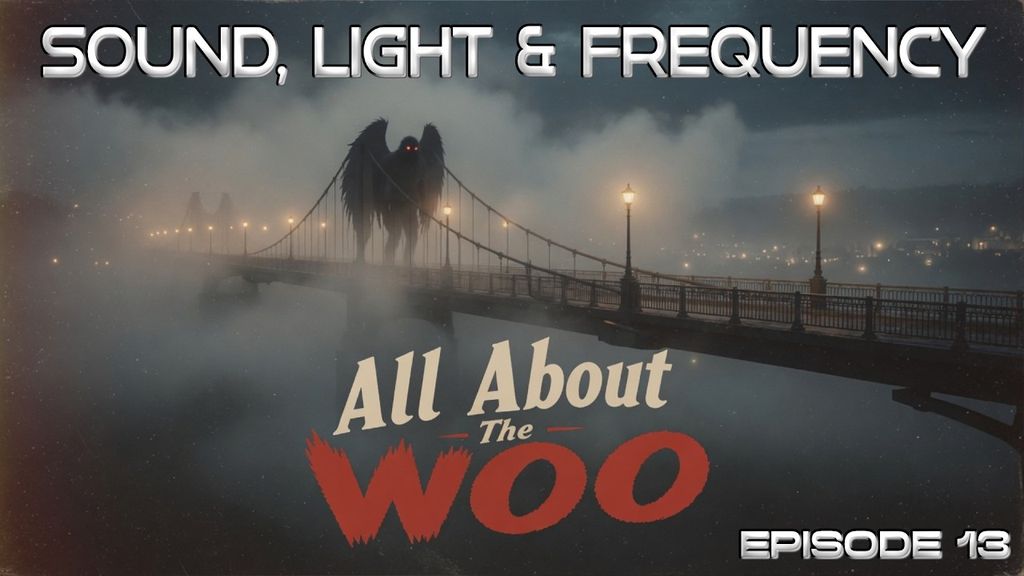
Sound, Light and Frequency Hosts Argue Woo Experiences Are Integral to the UFO Phenomenon


Sound, Light and Frequency hosts Bryce Zabel and Brent Friedman devote this installment to the woo factor, arguing that experiences often dismissed as paranormal or metaphysical are integral to understanding the UFO and UAP phenomenon. Rather than dissecting the latest government file release tied to the Trump‑era disclosure process, they pivot toward what they see as the more unsettling frontier of disclosure: the possibility that whatever underlies UFO reports is intertwined with consciousness and can respond to human attention.
The conversation begins with the latest document dump and the mixed signals around it. Zabel notes that the newly released photos, videos and files add little to what seasoned researchers already know, but he welcomes the fact that a formal release process now exists. Friedman is struck less by the content than by reactions on Capitol Hill, including a congressman’s claim that far more dramatic revelations are still ahead and reports that other members of Congress privately briefed pastors to prepare their congregations for what might follow. For the hosts, those details hint that forthcoming disclosures may challenge religious and existential assumptions more than they expand technical knowledge about craft.
From that starting point, Zabel and Friedman define what they mean by woo in a UAP context. Conventional ufology has often prioritized nuts‑and‑bolts evidence: radar tracks, cockpit footage, crash retrieval claims and propulsion analysis. Woo, as they use the term, encompasses the elements that refuse to stay in that box: telepathy, synchronicity, remote viewing, out‑of‑body experiences, apparitions, orbs, time slips, prophetic dreams, poltergeists, cryptids, hitchhiker effects and other forms of high strangeness. The hosts emphasize that researchers historically avoided these topics for fear of losing credibility, but argue that the pattern of cases and testimony makes it difficult to cordon off this territory from the UFO and UAP mystery.
Friedman then lays out a thesis he has developed over years as an experiencer and storyteller. In mainstream culture, aliens and UFOs, the paranormal and the afterlife are treated as three distinct domains, with separate communities of interest, genres and research traditions. His contention is that these domains are facets of the same underlying system. In this view, consciousness and energy—expressed in terms of sound, light and frequency—form the connective tissue between them. Humans, he suggests, are energy beings encountering other forms of energy and intelligence, with quantum entanglement offering a partial scientific metaphor for how attention, intention and anomalous events might intertwine.
Zabel extends the argument historically, noting that descriptions of non‑human encounters appear to change with era and culture while the structure of the encounters remains similar. In the late nineteenth century, witnesses reported mysterious airships; in earlier centuries, people spoke of fairies and supernatural beings; in the mid‑twentieth century, they described metallic disks and later more complex craft. Today, abduction narratives dominate parts of the literature. The language shifts, but common elements—ruptures in ordinary reality, distortions of time, meaningful messages, and interactions with human‑like or near‑human entities—recur. For the hosts, this suggests that culture acts as a filter of consciousness, shaping how people interpret a consistent underlying stimulus.
To frame woo within a broader intellectual tradition, Friedman points to early twentieth‑century authors whose work anticipated many current debates. H.P. Lovecraft, writing speculative fiction in the 1920s and 1930s, imagined humanity coexisting with vast non‑human intelligences that remain mostly unseen and induce madness when perceived. Zabel highlights how Lovecraft’s stories revolve around forbidden knowledge, cult transmissions, hidden dimensions and what contemporary UAP discourse now labels ontological shock—the trauma of realizing that reality is larger and less human‑centered than assumed. Although Lovecraft wrote fiction, his depiction of non‑human intelligences and altered minds foreshadowed issues now raised by UAP witnesses and theorists.
Alongside Lovecraft, Charles Fort compiled real‑world anomalies from newspapers and historical accounts in works like The Book of the Damned. Fort collected reports of objects falling from the sky that should not exist, mysterious lights, disappearances, bizarre weather and strange creatures—exactly the sort of data that modern investigators label anomalous but that seldom fit established scientific models. In the hosts’ reading, Fort and Lovecraft together establish a template: one catalogues inexplicable events; the other explores the psychological impact of confronting non‑human intelligences and altered realities.
The discussion then turns to Jacques Vallée, whose work bridges earlier anomalies and contemporary UFO research. Vallée’s Passport to Magonia and subsequent books argue that what people now call UFOs and UAP may not be a new phenomenon at all, but a modern expression of an enduring presence that once appeared as angels, demons, fairies or other mythic beings. Vallée focuses on structural similarities between historical and modern encounters—missing time, luminous entities, symbolic messages—and proposes that the phenomenon adapts its appearance and narrative content to prevailing cultural expectations. Zabel notes that current debates in Congress, where some members frame UAP as craft and others as angels and demons, echo Vallée’s core thesis that interpretation tracks cultural context rather than the underlying reality.
John Keel’s The Mothman Prophecies provides, in their view, a pivotal modern case study in woo. Keel, an investigative journalist, documented a wave of high strangeness in Point Pleasant, West Virginia in 1966–1967, centered on sightings of a large winged humanoid dubbed the Mothman and culminating in a fatal bridge collapse. Friedman describes reading the book as both terrifying and exhilarating, because Keel approached the events soberly yet encountered entities and incidents that defied tidy categorization: a towering cryptid with burning red eyes, uncanny telephone voices, apparent computer‑like speech, men in black and a cascade of coincidences and precognitions. Keel’s central observation—that focusing serious attention on the phenomenon can pull the investigator inside it—becomes a through‑line for the episode.
Zabel illustrates that dynamic with his own experience connected to The Mothman Prophecies. While producing the television series Dark Skies in the mid‑1990s, he began reading Keel’s book at Friedman’s urging, keeping his copy in the back seat of his car. One night, leaving a movie theater in Agoura Hills with his young son, he noticed a man in a long black duster walking toward them through a dimly lit parking lot. Concerned, he moved his son to the far side and avoided eye contact. As the stranger passed, Zabel saw that the man was carrying a copy of The Mothman Prophecies—the same relatively obscure book Zabel was reading and had in his own car. The incident, while not overtly threatening, left him with the strong impression that his investigation had somehow been noticed or echoed by something outside his control.
From there, Friedman shares a series of intensely personal accounts that illustrate how woo has manifested in his own life. He explains that from age five to around forty he repeatedly and inexplicably encountered violent deaths of strangers in close proximity. The first came as a child in the Bay Area when he watched a motorcyclist beheaded in an accident, her head rolling across the street before his father shielded his view. Years later, as a teenager on a first date on Telegraph Avenue in Berkeley, a man jumped from a third‑story window and landed a foot in front of him, dying instantly. In a macabre aside, the hotel clerk responded to Friedman’s report with indifference, noting that the jumper, “Carl,” had leapt before.
The final of the six deaths occurred outside the Dark Skies production offices in North Hollywood. Friedman recalls hearing an explosion, seeing that one car had flipped into a fenced lot while another had veered into a parking area, and sending his assistant to call 911. A teenage driver fled the scene, leaving an older man slumped in the passenger seat. As Friedman opened the door and took the man’s trembling hand, he felt what he describes as a powerful electrical shock and a surge of energy moving through him. In a span of seconds, he perceived vivid images of the man’s life, heard Spanish as if from the man’s memories, and then felt the presence leave as the man died. Immediately afterward, a small child in the back seat sat up and cried “Papa,” apparently sensing the same moment of passing.
For Friedman, that episode crystallized his sense that human beings are energy beings and that consciousness may be transferable or perceivable at death. It also reframed his earlier exposure to violent deaths: rather than viewing them solely as a curse, he came to see them as a brutal preparation for his own confrontation with mortality during a later cancer crisis, when he experienced high fever, sepsis and what he interpreted as encounters with light beings at the foot of his hospital bed. Zabel, who knew him during that period, notes that Friedman met his illness with unusual calm, which Friedman attributes in part to having already “faced death” repeatedly as a witness.
The hosts tie these episodes back to themes emerging from Skinwalker Ranch, where investigators have reported the hitchhiker effect—phenomena that appear to follow them home and then affect family members, often in the form of orbs or other anomalous manifestations. They point out that Brandon Fugal’s current Secrets of Skinwalker Ranch series, building on work initiated under Robert Bigelow’s ownership, is explicitly trying to measure and document such woo with instrumentation. While the televised investigations vary in evidentiary strength, Zabel and Friedman see value in attempts to quantify experiences that otherwise remain in anecdotal form.
In that context, Friedman relates what may be his most disturbing personal experience, an encounter in his Los Angeles bedroom that parallels old European folklore. As a working screenwriter developing a ghost‑comedy script, he had been researching afterlife stories but struggling to find an authentic anchor for a scene in which the protagonist meets his deceased wife. One late morning, after sleeping in and sitting on his bed reading the Los Angeles Times with his cat, he idly wondered again how such a meeting might truly feel. He then heard a clear inner voice say, “I’m right here. I’m right here. I’m right here.”
Lowering the paper, he saw a three‑dimensional yet translucent woman standing at the foot of the bed, with long stringy blonde hair and a tattered sundress. Her eyes appeared as rough black holes, like circles scribbled in charcoal by a child, undulating at their edges. In a sudden rush of motion, his cat launched off the bed, his body slammed against the headboard and he felt intense pressure on his upper arms. The woman had, in his account, leapt onto him, pinning his biceps with her knees and positioning her face inches from his. Looking into her dark eye‑sockets, he saw an expansive starfield, a vision of the cosmos, and felt his consciousness being drawn up and out of his body through those eyes in a powerful, vacuum‑like pull.
At that critical moment, the same inner voice returned, this time with a different message: “Just look away. Just look away.” Experiencing the command as absolute, Friedman forced himself to turn his head, at which point the figure vanished and the pull ceased. In the aftermath, he found his perception dramatically heightened, able to zoom visually into the stucco patterns of his walls and ceiling as if they were vast landscapes. The experience left him feeling intensely alive and energized rather than afraid; he even involuntarily called out “Come back,” unwilling to lose that state.
Friends initially dismissed the event as a waking dream or imaginative spillover from his script work. Over time, he began to doubt himself, until a friend directed him to the Whole Earth Catalog at a local Melrose Avenue store. There, on a specified page, Friedman found a reference to an out‑of‑print volume titled Witch Rider, containing traditional accounts from Eastern Europe and Scandinavia of a female entity—also called the old hag—that appears at the foot of a sleeper’s bed, jumps on them and attempts to steal their soul. The folklore holds that if the victim does not resist, they may be found dead in bed the next day.
Reading that description in a crowded bookstore triggered a delayed wave of fear that had been absent during the actual encounter. The close match between his experience and centuries‑old reports from distant cultures, down to the entity’s position at the foot of the bed and the sense of a soul‑threatening attack, made the world feel both smaller and more precarious. Zabel independently corroborates the motif, recalling that while researching afterlife material for his series The Crow: Stairway to Heaven, he encountered similar descriptions of the old hag in another book, lending support to Friedman’s claim that he only later discovered the folklore.
Skeptical interpretations frame such events as sleep paralysis—an archetypal nightmare experienced across time and cultures. Friedman acknowledges this but points out that the consistency of the entity’s appearance and behavior across centuries remains noteworthy. He also emphasizes that his episode occurred at noon after a full night’s sleep and while he was already awake and reading. A medium he consulted years later offered a different reframing of the inner voice: rather than attributing the “I’m right here” message to the entity, she suggested it came from his higher self or a guardian aspect of his own consciousness. In this interpretation, the voice was signaling that he would not be alone in the experience and then actively intervened with “Just look away” to preserve his life.
This higher‑self explanation leads the hosts to argue for a third explanatory lane beyond the binary of angels and demons or extraterrestrial visitors. In their view, some woo experiences may involve interactions between human consciousness and external non‑human intelligences, while others may reflect complex dynamics within consciousness itself, including protective mechanisms that manifest as voices or intuitions. Either way, the common factor is consciousness operating within a reality that includes energies and intelligences not currently understood.
To illustrate how woo can manifest in more subtle ways, Zabel recounts an incident from the writing of his book A.D. After Disclosure with Richard Dolan. The two had discussed, in a private phone call, patterns involving the number three in UFO cases—three‑fingered beings, triangular craft with three lights and other triadic motifs. They were not co‑editing documents in real time, and Zabel’s research notes file remained local on his computer. When he opened that file the next day, he found three full lines of the digit “3” inserted mid‑page, as if a key had been held down continuously. No one else had access to the file. For him, the unexplained insertion felt like an acknowledgement—either from the phenomenon itself or from human eavesdroppers—that their line of thinking had been noticed.
Across these stories, Zabel and Friedman repeatedly return to the Trickster motif that Keel and Vallée have both highlighted. Non‑human intelligences, if that is what lies behind some woo incidents, often seem to misdirect, taunt or play games with investigators, sending them down blind alleys or presenting ambiguous signs that are unsettling rather than overtly harmful. The cryptic lines of threes, the stranger with The Mothman Prophecies, the catastrophic but eerily patterned deaths, the hitchhiker‑like contagion of the old hag story to listeners’ own bedrooms—each fits the pattern of a phenomenon that not only stares back when observed but appears to tease the observer.
The hosts close by situating this exploration of woo within the larger UAP discourse and within popular media. They point listeners to Twin Peaks as perhaps television’s most sustained treatment of woo, with its recurring line “The owls are not what they seem” and its web of entities, portals and altered realities. They mention Phenomenon as a fictional portrayal of a human download experience; Picnic at Hanging Rock as a slow, atmospheric account of an unexplained disappearance; Annihilation and Solaris as narratives in which alien environments communicate through transformation and duplication rather than speech; and smaller films like Coherence, The Nines and A Ghost Story as meditations on shifting timelines, layered realities and non‑linear afterlife experiences.
For Zabel and Friedman, these films and series act as portals, much like the works of Lovecraft, Fort, Vallée and Keel, providing narrative frameworks for thinking about woo when formal science has few tools for engaging it. They stress that as disclosure efforts proceed—through legislation, hearings, declassifications and testimony—technical data on craft and propulsion is only part of the picture. If non‑human intelligences are present and engaged, that engagement may operate through consciousness, synchronicity, symbolic communication and high strangeness as often as through visible vehicles in the sky. In their assessment, many more people will recognize themselves in woo experiences than in classic UFO encounters, making this dimension not a fringe add‑on but a central component of any comprehensive effort to understand UAP and its implications for human reality.
Key Moments
- 00:34In the wake of a new government UFO document release linked to the Trump-era disclosure movement, the hosts focus less on the initial 'not that exciting' files and more on a congressman’s teaser of future 'holy crap' revelations and private briefings given to pastors to prepare religious communities for what may be coming.
- 04:32Bryce and Brent define 'woo' in ufology as the non–nuts‑and‑bolts side of the phenomenon—telepathy, synchronicity, remote viewing, out‑of‑body experiences, apparitions, orbs, time slips, prophetic dreams, poltergeists, cryptids, coincidences and hitchhiker effects—that resist conventional UFO categories.
- 05:45Friedman lays out his core theory that aliens and UFOs, the paranormal, and the afterlife are not separate mysteries but manifestations of a single system whose connective tissue is consciousness, energy, sound, light and frequency, with culture and era determining how encounters are perceived and described.
- 07:46The hosts draw on historical reports of airships, fairies and abductions to argue that the 'costume' of encounters changes over time while the underlying structure—ruptures in reality, distorted time, meaningful messages and human‑like or near‑human beings—remains consistent.
- 09:44They trace a literary lineage for woo through H.P. Lovecraft’s fiction about hidden non‑human intelligences and ontological shock, Charles Fort’s cataloguing of anomalous events, and Jacques Vallée’s thesis that a single phenomenon has been interpreted variously as angels, demons or spacecraft depending on the age.
- 16:50John Keel’s 'The Mothman Prophecies' is presented as a modern investigative template for woo: a journalist drawn into a year‑long wave of high strangeness in Point Pleasant, West Virginia, where non‑human intelligences appear as cryptids, disembodied voices, men in black and other trickster manifestations.
- 20:08Zabel recounts a personal synchronicity in which, while reading 'The Mothman Prophecies' during Dark Skies production, he encountered a menacing stranger in an Agoura Hills parking lot carrying the same obscure book, reinforcing questions about whether investigating the phenomenon invites it to interact.
- 34:12Friedman discloses a lifetime pattern of six strangers dying violently in his immediate vicinity, beginning with a decapitation he witnessed at age five and including a suicide on Telegraph Avenue and a fatal car crash outside the Dark Skies offices in which he believes he directly experienced a man’s life force passing through him.
- 42:16In the Dark Skies–era crash, Friedman reports holding an injured man’s hand, feeling an electrical surge and seeing rapid images of the man’s life while hearing Spanish, immediately before the man died and his young son in the back seat cried 'Papa,' reinforcing his belief that humans are energy beings and that some aspect of consciousness can transfer or be perceived at death.
- 44:14The discussion links such experiences to reports of orbs, foo fighters and crop circles, and to the 'hitchhiker effect' at Skinwalker Ranch, where phenomena appear to follow investigators home, suggesting that focused attention and investigation may entangle observers with non‑human intelligences.
- 48:47Friedman describes a daytime bedroom encounter in Los Angeles in which a translucent woman with charcoal‑black, star‑filled eyes appeared at the foot of his bed, leapt on him and seemed to pull his consciousness out through her eyes until an insistent inner voice told him to 'just look away,' breaking the episode.
- 53:32Later discovering the 'witch rider' or 'old hag' folklore—stories of a female entity that appears at the foot of the bed to steal a sleeper’s soul unless resisted—through the Whole Earth Catalog, Friedman concluded that his experience closely matched centuries‑old reports from Europe and Scandinavia, intensifying his sense that time and distance pose little barrier to the phenomenon.
- 57:50A medium later suggested to Friedman that the voice saying 'I'm right here' and 'just look away' may have been his higher self or a guardian aspect of his own consciousness rather than the attacking entity, implying a third category beyond angels, demons or aliens in which an inner guidance system helps navigate traumatic woo events.
- 01:00:37Zabel adds a 'power of three' incident from the writing of 'A.D. After Disclosure,' where, after an off‑line conversation with Richard Dolan about the significance of the number three in craft shapes and beings, he opened his private notes file to find three full lines of the digit '3' that neither he nor Dolan had typed, leaving him with the impression that someone or something was monitoring or acknowledging their work.
- 01:04:52The episode closes with a series of film and television recommendations that embody woo—Twin Peaks, Phenomenon, Picnic at Hanging Rock, Annihilation, Solaris, Coherence, The Nines and A Ghost Story—and with the argument that many more people likely experience woo phenomena than overt UFO sightings, making this dimension central to any serious study of UAP and non‑human intelligence.
 Continue with Google