
Archival Tapes, Academic Debate, and Consciousness Claims Reignite UAP Community Discussion


Debate over unidentified anomalous phenomena remains polarized between demands for verifiable data and a growing corpus of cultural, historical, and testimonial material. A recent Psicoactivo Podcast installment brought three distinct strands into focus: newly publicized archival audio linked to Gene Roddenberry’s exposure to 1970s channeling sessions known as 'The Nine'; an academic exploration by religious studies scholar Diana Walsh Pasulka into how UFO beliefs mirror early religious movements; and a speculative physics-of-consciousness model proposed by engineer Bob Greenyer. Layered over these were community questions about evidence, historic case studies, and whether policy or popular media could catalyze a breakthrough in public understanding.
Historical claims and the Roddenberry tapes
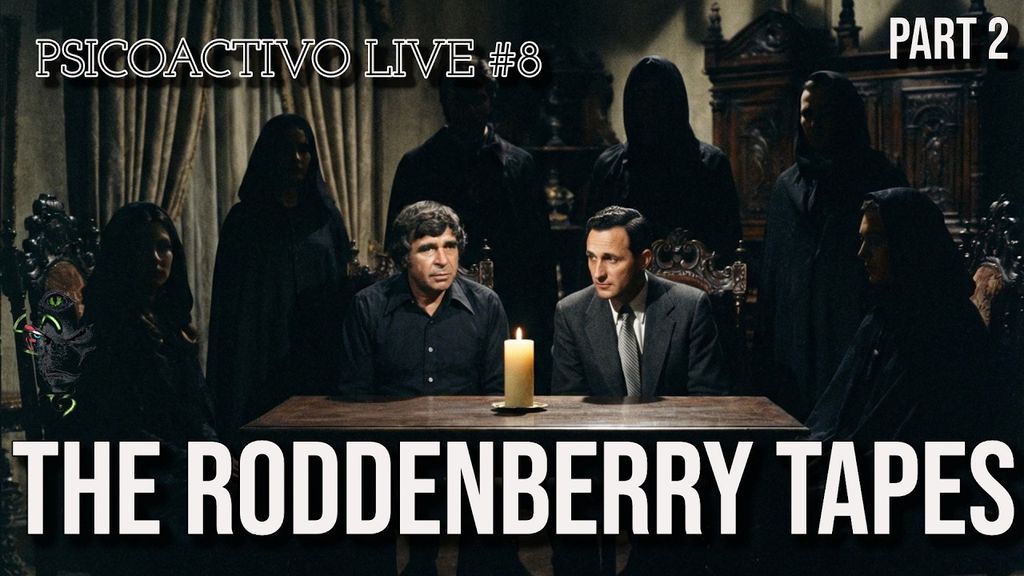
Archival releases curated by filmmaker Greg Mallozzi on The Cosmic Clock have revived interest in a long-circulating story: that Andrija Puharich’s private sessions with the 'Council of Nine' intersected with the creative life of Star Trek creator Gene Roddenberry. The tapes reference a milieu in which participants adopted aliases—Rodenberry is referred to as 'Jonathan'—and a channeler describes a cosmology of 24 advanced civilizations overseen by a central council. Such recordings are cultural artifacts, not scientific datasets, and their content reflects a metaphysical narrative rather than empirical observation.
The material includes assertions that directly conflict with established physics, such as references to beings existing in 'other dimensions' and a claim that a civilization’s 'velocity envelope' reaches 56 times the speed of light. It also presents a spiritual anthropology describing Earth as a reincarnational bottleneck—a moral-psychological framing of human life rarely addressed in UAP research. Notably, Roddenberry reportedly sought a 'sign' to assist with a script he intended to develop from these ideas, underscoring how anomalous themes can influence creative work even while remaining unverifiable.
The archival effort’s value is clear: it preserves primary-source audio that allows researchers to place later cultural narratives in context. It also highlights a recurring feature of UAP history—the blending of technological motifs, metaphysical claims, and personal testimony. Whether these sessions illuminate any non-human intelligence is unresolved; their cultural significance, however, is not in doubt, as they map a lineage connecting 1970s parapsychology, speculative cosmology, and mainstream entertainment.
Belief, evidence, and the sociology of a movement
Diana Walsh Pasulka’s comparative lens situates contemporary UFO belief within the long arc of religious history. In a new interview with El País, Pasulka—author of American Cosmic—argues that the structure of contemporary UAP belief and practice resembles early Christian movements: decentralized, participatory, and often catalyzed by transformative experiences. Rather than adjudicating truth claims, she catalogs how people interpret experiences they cannot easily classify, how communities coalesce around those experiences, and how interpretations shift across scientific, military, and religious contexts.
Her assessment observes that within U.S. government and defense circles, belief in UAP reality can coexist with divergent explanatory frameworks: some personnel interpret experiences through theological categories such as angels and demons, while others evaluate events as potential foreign or unknown technological threats. Crucially, Pasulka reports having been shown a purported crash 'debris field' in New Mexico and relays that two highly placed scientists considered isotopic ratios and apparent aging characteristics inconsistent with known terrestrial manufacturing. She stops short of endorsing their conclusion, documenting instead the conviction of her sources. It is an important distinction: compelling scientific claims must survive independent replication and peer review, yet the reporting itself reflects real intra-institutional belief dynamics.
Pasulka also tracks how apocalyptic or eschatological motifs emerge among some experiencers, many of whom subsequently embrace environmental and anti-nuclear activism. This pattern—intense subjective encounters followed by urgent moral reorientation—echoes the behavior of nascent religious communities throughout history. Her analysis neither validates nor dismisses the experiences; it shows how anomalous encounters can function sociologically, seeding new norms, narratives, and projects of meaning. It also spotlights a pragmatic tension: while many academics avoid engagement due to peer pressures, data-oriented fieldwork—archival mining, oral histories, and interdisciplinary collaboration—remains indispensable if the subject is to move beyond polemic.
Speculative physics and the consciousness question
Bob Greenyer’s presentation, shared via a podcast exchange, attempts to ground consciousness in a physical substrate. He suggests a cosmos permeated by a 'relic neutrino' superfluid and describes the brain’s electromagnetic activity as a toroidal 'moment' that encodes information into this medium, likening personal identity to ripples that do not dissipate. From there, he extends the model toward reincarnation, karma, and a panpsychist continuum in which animals—and even inanimate matter—participate in varying degrees of awareness.
The proposal challenges mainstream positions in both neuroscience and physics. Contemporary research strongly ties consciousness to neural correlates in the brain rather than an exogenous field, and no consensus model supports a neutrino-based superfluid memory that preserves individual identity after death. Still, Greenyer’s framing aligns with enduring interests among some UAP researchers who suspect that anomalous observations may be entangled with observer effects, psi claims, or a deeper physics of information. Progress here will hinge on testable predictions, instrumentation that can discriminate among competing hypotheses, and transparent publication practices that invite independent critique.
An unverified anecdote from the Reagan era
A striking story came via producer Brent Friedman, who recounted a personal conversation with John S. Herrington, Secretary of Energy under President Ronald Reagan. According to Friedman, Herrington returned from classified briefings conducted at an underground facility, described emotional distress, and told him that alien beings are real. The claim, presented as a firsthand anecdote, is uncorroborated. Herrington is a documented public figure who served in that role from 1985 to 1989; the content of any briefings remains classified, and no official record supports the assertion relayed here. Nonetheless, such stories continue to circulate within the community, often cited as indicators that more sensitive knowledge may exist behind classification walls.
Evidence standards and the role of archives
A recurrent theme across the program’s discussion and Q&A was the difference between testimony and demonstrable evidence. The host emphasized corroboration—drawings, photographs, instrumented data—when platforming civilian witnesses, citing repositories like the 'Archives of the Impossible' and the Roswell museum as essential resources for skeptics and newcomers. Two historical cases were flagged for closer scrutiny: Brazil’s 1977 Colares 'Operation Saucer,' a months-long series of reports investigated by the Brazilian Air Force that generated official documents and medical accounts; and a 1977 California wave characterized by sightings near schools, presently being compiled through newspaper archives and interviews.
These cases are valuable not because they close debate, but because they offer dense, multi-source records that can be revisited with contemporary tools. Geospatial analysis, modern image forensics, atmospheric modeling, and renewed witness outreach can wring new insights from old events. In a field that often leans on isolated testimony, such dossiers provide test beds for methodological rigor.
Policy, secrecy, and public perception
Audience questions reflected broader anxieties about whether governmental mechanisms can resolve core evidentiary disputes. Some participants argued that a single, authentic document or sensor record—sufficiently detailed and independently verifiable—could recalibrate public opinion. Yet the discussion acknowledged persistent obstacles: the compartmentalization of sensitive programs, executive-branch 'need-to-know' practices that may exclude presidents from certain compartments, and the likelihood that any technology-related details would remain tightly controlled for national security reasons. The net result is a paradox: even if confirmatory evidence exists within classified channels, its release pathway is unclear, and geopolitical crises routinely eclipse the issue’s legislative momentum.
The Middle East and difficult datasets
Questions also addressed reports from conflict zones—including the Middle East—where ambiguous videos circulate on social media. These materials are typically low-fidelity, context-poor, and vulnerable to misattribution or digital manipulation. The conversation underscored the need for provenance chains, original sensor metadata, and on-the-ground corroboration to distinguish genuine anomalies from drones, munitions, atmospheric artifacts, or CGI. Without such standards, war-zone footage risks amplifying noise rather than clarifying patterns.
Psi, trauma, and the experiential frontier
Beyond craft-like UAP, the dialogue ventured into psi claims—remote viewing, telepathy, and anomalous cognition—referencing historical figures such as Ingo Swann and Pat Price and an oft-repeated story involving President Jimmy Carter. While the evidentiary record here is contested, peer-reviewed meta-analyses from parapsychology are part of the literature and remain of interest to some researchers. A controversial but recurring claim is that trauma and certain altered states may increase reported psi effects. If studied, such assertions require careful ethical frameworks, rigorous controls, and close attention to replication. They also illustrate why the UAP conversation frequently overlaps with consciousness research and anthropology: the line between perceived phenomena and human interpretive frameworks can be difficult to fix.
Culture-makers and their influence
Speculation surfaced about whether popular films—especially those that consult with scientists or defense figures—can 'move the needle' on public engagement. Historically, cinema has shaped expectations about contact, disclosure, and risk, sometimes anticipating topics later broached by officials and journalists. That influence, however, is sociological rather than evidentiary. Films can set agendas, draw new participants into the conversation, and pressure institutions to respond, but they do not replace the need for verifiable records, transparent methodologies, and replicable findings.
Where research can go from here
The intersection of archival publication, academic analysis, and speculative science points to a workable agenda. First, continued digitization and open access to primary sources—from military files to obscure local newspapers—would expand the evidentiary base. Second, interdisciplinary teams that include historians, anthropologists, physicists, and data scientists could reexamine high-signal historical cases with modern tools and publish results in venues that invite peer review. Third, any claims linking artifacts to non-terrestrial origins must be supported by chain-of-custody documentation, transparent sample preparation, and multi-lab replication of isotopic and structural data. Fourth, consciousness-related hypotheses that touch UAP observation or experiencer reports should articulate testable predictions and accept outcomes regardless of whether they confirm or falsify initial premises.
A measured conclusion
The Psicoactivo discussion illustrates why UAP remains a uniquely difficult domain. Archival tapes preserve a legacy of esoteric ideas that helped shape a generation’s imagination; a scholar of religion maps striking parallels between contemporary UFO belief and the formation of early religious communities; and a technologist-creator advances a provocative, if currently unorthodox, model of consciousness. Anecdotes about high-level officials hint at undisclosed knowledge while underscoring the chasm between classified briefings and public evidence.
Whether these streams ultimately converge into a coherent understanding depends less on any single revelation than on process: transparent sourcing, reproducible methods, and an openness to results that may confirm, complicate, or overturn prevailing narratives. For a topic that touches on national security, scientific frontier, and human meaning-making, that discipline may be the most consequential development of all.
Key Moments
- 02:34Release of The Cosmic Clock’s Part 2 of the Gene Roddenberry tapes, centered on 1970s channeling sessions associated with Andrija Puharich and 'The Nine.'
- 05:48Physicist Jack Sarfatti is cited as having referenced Roddenberry’s exposure to 'The Nine' in a London lecture, with the caveat that Star Trek’s original 1966 series predated the 1970s recordings.
- 07:43A recorded remark attributed to Roddenberry suggests he had participated in earlier sessions—'the same way he entered the other communications'—raising questions about the duration of his involvement.
- 10:09Channeling content describes 24 advanced civilizations overseen by a 'Council of Nine' and assisting Earth—claims presented without independent corroboration.
- 14:06The channeling asserts a civilization’s 'velocity envelope' as '56 times the velocity of light,' a statement incompatible with established physics.
- 18:10A metaphysical claim describes Earth as a 'bottleneck' for reincarnating souls reluctant to progress—an example of the tapes’ spiritual cosmology.
- 19:12Rodenberry reportedly asked for a 'sign' to aid a script inspired by the sessions; the script was never produced, and its contents are slated for further analysis by The Cosmic Clock.
- 24:47El País features Diana Walsh Pasulka arguing that belief in UFOs resembles early Christian dynamics; she approaches the topic as a comparative religion scholar rather than an advocate.
- 32:03Pasulka observes that many in U.S. government and military circles study UAP with divergent interpretations, ranging from theological (angels/demons) to national security concerns.
- 35:58Pasulka recounts being shown an alleged mid-20th-century crash 'debris field' in New Mexico and relays that two unnamed top scientists found isotopic and aging data persuasive of non-terrestrial origin; she reports their convictions rather than endorsing a conclusion.
- 38:05Pasulka frames a potential 'emerging religiosity' combining mystery with purported scientific evidence, suggesting that if validated, faith requirements could diminish.
- 42:19She notes apocalyptic visions among some experiencers who subsequently adopt environmental and anti-nuclear activism, paralleling urgent moral movements in early Christianity.
- 49:26Bob Greenyer proposes a speculative 'relic neutrino' superfluid substrate for reality and toroidal brain fields encoding consciousness—claims that diverge from mainstream neuroscience and physics.
- 01:02:00Producer Brent Friedman recounts that former Reagan-era Secretary of Energy John S. Herrington told him alien beings are real after emotionally difficult classified briefings—an anecdote not independently verified.
- 01:26:44For skeptics, the host highlights Brazil’s 1977 Colares 'Operation Saucer' and a 1977 California school-sighting wave as historically rich cases meriting archival review.
Related Topics
Links & References
- The Cosmic Clock: The Gene Roddenberry Tapes, Part 1.
- The Cosmic Clock: The Gene Roddenberry Tapes, Part 2, discussed during the program.
- El País interview with Diana Walsh Pasulka on UFO belief as an emerging religiosity.
- Matt Beall’s post promoting Bob Greenyer’s consciousness theory discussion.
- Astral’s post quoting producer Brent Friedman on former Energy Secretary John S. Herrington.
- Background link referencing Puharich and directed-energy topics shared in the show’s source list.
- Psicoactivo Podcast channel page for additional episodes and context.
- Anomalous Cards site mentioned for community sponsorship; included as part of the program’s references.
 Continue with Google