
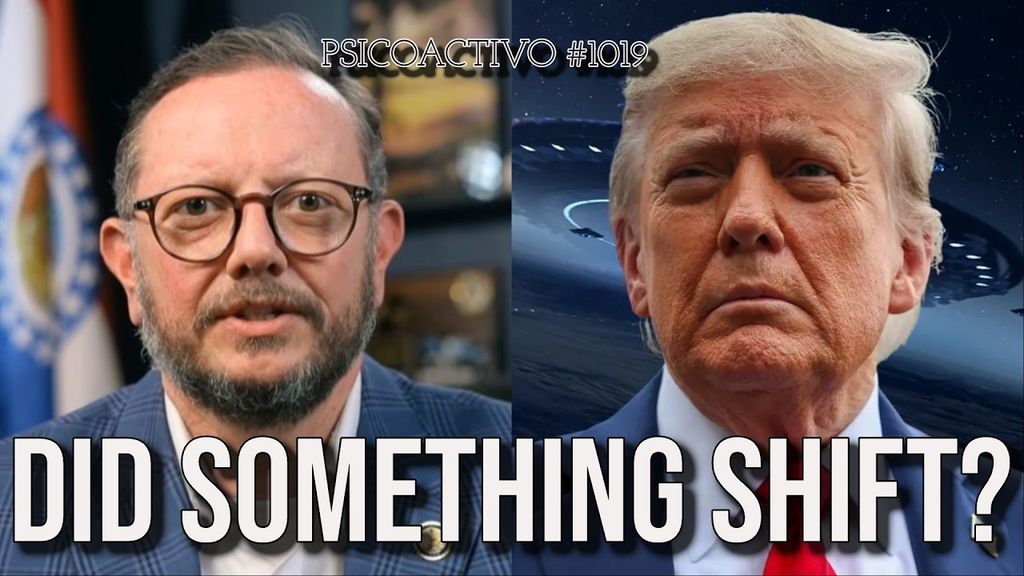
Eric Burlison Describes Classified UAP Videos as White House Seeks His Guidance on Disclosure


Representative Eric Burlison’s description of newly viewed UAP videos, combined with a direct request for guidance from the White House, signals a notable change in how senior officials are engaging with both Congress and outside investigators on unidentified anomalous phenomena. In this Psicoactivo episode, host Pavel Ibarrameda connects Burlison’s account to the ongoing work of Jeremy Corbell and others, outlining a possible move toward more structured disclosure, including a planned sequence of document and video releases.
Pavel opens by citing sources close to the White House who report growing optimism among staff working with President Donald Trump on declassification efforts related to UAP. He contrasts the relative silence from members of Congress before a recent Thursday‑night briefing with the much more detailed comments that followed it from Burlison. According to Pavel, that briefing appears to be the first time Burlison was shown what he himself characterized as “the good stuff” in terms of UAP videos, footage striking enough that one clip caused the entire room to react audibly.
A key portion of the episode revisits Jeremy Corbell’s lengthy Area 52 interview with host Chris Ramsay. Ramsay presses Corbell for concrete examples of what he calls “smoking gun evidence,” seeking descriptions of craft shapes, markings, and sensor types. Corbell answers by distinguishing everyday expectations of crystal‑clear cinematic video from the realities of classified military full motion video. He describes having seen triangles, tic tacs, ovals, and spheres, but warns against assuming these are definitively “craft,” noting that the most detailed imagery often results from overlapping sensors—thermal, low‑light, and high‑resolution FMV—rather than a single camera.
In that same interview, Corbell recounts a striking case involving a Department of Energy–related critical infrastructure site protected by a Honeywell security system. According to his narrative, a three‑sided pyramid‑shaped object rose slowly from the water, rotated, and hovered over the facility for roughly ten hours before returning to the bay. Corbell says the security cameras captured exceptionally clear footage, yet when intermediaries later sought to ensure the material could be shared with investigators—including by involving the FBI—the video file was reportedly removed from the system. He uses this example, along with anecdotes from drone analysts watching Reaper feeds, to explain why high‑fidelity satellite and FMV imagery rarely reaches the public.
Corbell emphasizes that access to such high‑resolution UAP recordings is limited to a small group of cleared personnel. Only a fraction of them would consider breaking their oaths, fewer still would have cause or intent to do so, and almost none would choose to accept the legal risk of handing classified material to journalists. He stresses that he and journalist George Knapp have already obtained and released 13 military‑sourced assets that were never meant to be public, and he urges potential whistleblowers not to endanger themselves, arguing that there are other institutional paths for the truth to emerge.
Pavel then juxtaposes this caution with Burlison’s more recent public statements. On St. Louis station 97.1 FM, Burlison recounts receiving a call from the White House after a set of UAP videos was released. According to Burlison, officials asked him to “talk nice” about the release even though he had not yet been briefed on its contents and said the administration had not previously engaged with him on the topic. He says the White House acknowledged that he had effectively done the early reconnaissance on UAP issues and asked him for advice on where to take the investigation next and whom to interview, indicating a new level of collaboration between the executive branch and one of Congress’s more active UAP advocates.
Burlison goes on to describe an approximately ninety‑minute briefing with the Pentagon’s All‑domain Anomaly Resolution Office (AARO) in which he and others viewed about 30 UAP videos. In his retelling, one video showed an object apparently flying with the wind at what he estimates might have been around 80 miles per hour, before it instantaneously accelerated to what he called “Mach speed.” Burlison says that moment prompted a collective gasp in the room, including from staffers he characterizes as the most skeptical attendees, and he asserts that no known aerial platform can replicate such a performance. A second video, which he began to describe before the radio interview shifted to another topic, reportedly showed a Russian submarine being shadowed by three maneuvering objects that ultimately drew the camera operator’s focus away from the submarine itself.
Pavel argues that Burlison’s comments function as a de facto answer to Ramsay’s earlier question to Corbell about whether anyone has seen “clear as day” UAP videos and what they depict. While Corbell stresses classification constraints and chain‑of‑custody issues, Burlison confirms that AARO is still declassifying content, that additional videos and documents are in the pipeline, and that the White House is now soliciting his input on investigative priorities. Pavel shares information that planned disclosure “drops” are expected roughly every two weeks, each comprising around 200 items, and that the forthcoming batch may include more than 40 UAP videos Corbell has been trying to push through declassification channels.
The episode also touches on broader political dynamics in Congress. Pavel suggests that other lawmakers, including figures such as Tim Burchett and Anna Paulina Luna, are likely part of the same emerging line of communication with the White House, given their prominent roles in recent hearings and legislative pushes. He links this to developments surrounding Dylan Borland’s testimony at Oregon’s 2026 UFO Fest and prior September hearings, framing all of these moves as elements of an accelerating, more coordinated effort to resolve outstanding questions about past encounters, military reporting, and sensor data archives.
Beyond the political and intelligence dimensions, Pavel uses a sponsorship segment to highlight how civilian and cultural documentation of UAP history is evolving alongside official processes. He showcases “Anomalous Cards,” a trading‑card style project that profiles 30 UAP “heroes of truth,” including astronaut Gordon Cooper, whose post‑NASA accounts describe saucer‑shaped objects over Europe in 1951 and a filmed landing at Edwards Air Force Base in 1957, as well as a card depicting Dylan Borland’s black triangle sighting and the June 16, 2025 video that Corbell and Knapp presented to lawmakers. In Pavel’s view, such projects complement institutional disclosure by preserving testimonies and incidents that might otherwise remain scattered or inaccessible.
By the end of the episode, Pavel maintains that “something shifted” in the alignment between Congress, AARO, and the White House. Between Corbell’s behind‑the‑scenes descriptions of multi‑sensor data, Burlison’s public account of gasp‑inducing UAP videos, and plans for recurring declassification releases, he concludes that the coming months could bring a more systematic flow of official material into the public domain, even as key details about the most sensitive recordings remain tightly held.
Key Moments
- 00:24Pavel reports that people close to the White House describe growing optimism around a declassification effort involving President Donald Trump and members of Congress.
- 01:10He introduces criticism of filmmaker Jeremy Corbell’s Area 52 interview with Chris Ramsay, defending Corbell as authentic and visibly stressed while under pressure to reveal more about what he has seen.
- 02:27Pavel links that interview to comments made by Representative Eric Burlison on St. Louis radio station 97.1 FM, suggesting both moments point to a new phase in official engagement with UAP material.
- 02:49Burlison had highlighted newly released NASA imagery from the 1960s and 1970s and recent documents on military encounters, noting many older NASA photos remain unresolved despite being long public.
- 03:28According to Pavel’s recounting, Burlison described a Thursday‑night briefing where lawmakers viewed two particularly striking UAP videos, one of which made everyone in the room gasp.
- 03:39Burlison stated that the White House contacted him asking for help both in publicly characterizing recent video releases and in identifying who to interview next, acknowledging that he has effectively done the reconnaissance on the topic.
- 04:20Pavel cites information that future declassification “drops” are planned roughly every two weeks, with about 200 items each time and more than 40 UAP videos expected in the next batch, including material Jeremy Corbell has been trying to get declassified.
- 05:14In the Area 52 exchange, Chris Ramsay presses Corbell for specifics on clear UAP footage; Corbell responds by outlining multiple shapes—triangles, tic tacs, ovals, spheres—and explains that ‘clear as day’ often comes from multi‑sensor full motion video rather than cinematic 4K imagery.
- 12:45Corbell recounts a reported Honeywell security system recording of a pyramid‑shaped object lifting from water near a Department of Energy–related facility, hovering for around 10 hours, and then re‑entering the water before the footage was allegedly removed from the system.
- 14:53Corbell explains why the public does not see more high‑fidelity satellite and full motion video: access is tightly restricted, the pool of people with both clearance and willingness to break oaths is extremely small, and he urges sources not to take personal legal risks to leak such material.
- 19:02On 97.1 FM, Burlison says the White House admitted it had not engaged closely with Congress on UAP, asked him to speak positively about releases he had not yet seen, and then requested his guidance on where to direct further investigation and who to interview.
- 20:43Burlison reports an hour‑and‑a‑half briefing with AARO in which he viewed about 30 UAP videos; one showed an object apparently flying with the wind at perhaps 80 mph and then instantaneously accelerating to what he described as ‘Mach speed,’ prompting an audible reaction from everyone present.
- 22:06He also begins to describe a second video involving a Russian submarine being observed as three objects maneuver around it, drawing the camera operator’s attention away from the sub itself before the radio interviewer changes topics.
- 23:30Pavel underscores that it is unclear whether the forthcoming 40‑plus videos will include the 30 shown to Burlison or the 13 Air Force videos Corbell and George Knapp provided to Congress to support declassification, but he argues that ‘something shifted’ in how the executive branch is engaging the issue.
- 26:04In a sponsorship segment, Pavel highlights ‘Anomalous Cards,’ a trading‑card style project documenting 30 UAP ‘heroes of truth,’ including astronaut Gordon Cooper and a card depicting Dylan Burkett Borland’s black triangle testimony and the June 16, 2025 Corbell/Knapp video shown to lawmakers.
Related Topics
Links & References
- Support links and platforms for the Psicoactivo Podcast and host Pavel Ibarrameda.
- Marc Cox Show segment in which Representative Eric Burlison discusses recent UAP briefings and videos.
- Area 52 episode featuring Chris Ramsay interviewing Jeremy Corbell about UAP footage and evidence.
- Psicoactivo Podcast on Spotify, including episodes covering UAP disclosure developments.
- UFO Design 3D sponsor site offering UAP-themed designs, promoted in this Psicoactivo episode.
- Anomalous Cards website featuring UAP-themed trading cards such as the Heroes of Truth series.
 Continue with Google