
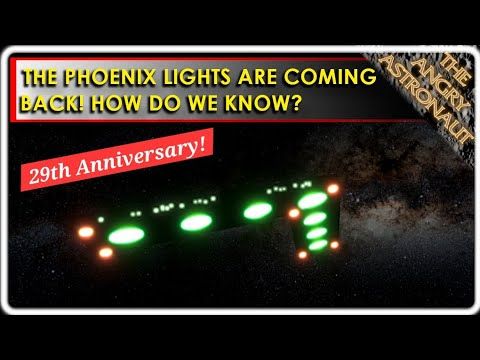
Phoenix Lights at 29: Comparative Patterns Across Lubbock (1951), Hudson Valley (1980s) and Arizona Sightings Revive Questions Over Recurrence


Mass-witness accounts of large, silent aerial formations have appeared periodically in U.S. skies for decades, most prominently in Texas in 1951, the Hudson Valley in the 1980s, and Arizona in 1997. The recurring descriptions — V-shaped or boomerang silhouettes, arrays of lights, and quiet, slow transits punctuated by abrupt accelerations — continue to fuel debate about whether these reports represent variations of known aircraft and atmospheric effects, or an unresolved category of Unidentified Anomalous Phenomena.
The Lubbock reports in 1951 stand out for their early proximity to academic observers and immediate attention from Project Blue Book. Three Texas Tech professors described 20–30 bluish-green lights in an organized formation moving quickly and silently, with subsequent sightings and widely circulated photographs by a student witness. Blue Book labeled the professors’ observations as unknown and found the photos not to be hoaxed yet inconclusive. An explanatory theory involving birds reflecting mercury-vapor streetlights has been contested by witnesses and local experts as inconsistent with reported altitude, speed, and silence. Blue Book chief Edward J. Ruppelt later alluded to an undisclosed natural explanation but did not publish the details.
In the 1980s, the Hudson Valley wave produced thousands of consistent accounts across several counties in New York and into western Connecticut. Witnesses, including police and security personnel, described massive, boomerang-shaped or triangular craft that drifted slowly over highways and population centers, sometimes reportedly emitting beams of light. An incident near the Indian Point nuclear facility intensified attention. While the Federal Aviation Administration cited ultralight aircraft as a likely source of confusion and acknowledged some pranks, many observers argued that the reported scale, silence, and maneuvering did not align with ultralight performance.
The Phoenix Lights case in 1997 is often framed as two distinct events: earlier, a broad V-shaped formation traversing multiple jurisdictions; later, a stationary line of lights widely attributed by the U.S. Air Force to flares released by A-10 aircraft at the Barry M. Goldwater Range. The flare explanation addresses the second episode but not the earlier, large formation, for which corroborating radar data has not been provided publicly. Astronomer Mitch Stanley reported seeing multiple aircraft through a telescope, a skeptical counterpoint to structured-craft descriptions. Years later, former Arizona governor Fife Symington publicly stated that he had observed a huge, quiet craft, a reversal from his earlier attempt to defuse public concern.
Advocates for a recurrence hypothesis note similarities among the three clusters and suggest a rough multi-decade cadence, projecting that a comparable mass-sighting event could surface near 2029. This notion rests on pattern matching rather than on independently verifiable periodic drivers. Related speculation about relativistic interstellar travel and candidate nearby stars frames one possible narrative but remains hypothetical, with no empirical link connecting specific stars to the reported events.
The unresolved status of these cases illustrates a recurring challenge in UAP inquiry: large volumes of consistent eyewitness testimony contrasted against limited, publicly available instrumented data. If a future mass-sighting occurs, rigorous, multi-sensor collection — including synchronized optical and infrared imaging, calibrated triangulation, and radar/ADS-B correlation — will be critical to resolving whether such formations reflect conventional activity, rare environmental effects, or an extraordinary category of phenomena. Until then, debates over flares, birds, ultralights, and unidentified formations are likely to persist, with the Phoenix Lights continuing to symbolize both the promise and the limits of UAP investigation.
Key Moments
- 00:14Introduction of the 'Tucson lights' via footage credited to Jeff Woolwine, who has reportedly filmed similar lights since the early 2000s, suggesting ongoing activity after 1997.
- 01:52Overview of the Phoenix Lights as a two-part event: reports of a massive, silent V-shaped craft traversing Arizona followed by a later series of stationary lights commonly attributed to military flares.
- 03:35Former Arizona Governor Fife Symington initially mocked the Phoenix reports, then later stated he had seen a large, silent craft and said his earlier stunt aimed to reduce public anxiety.
- 07:07Lubbock (Texas) 1951: three Texas Tech professors reported 20–30 bluish-green lights in a U/V formation moving silently and rapidly; multiple additional sightings followed, and student Carl Hart Jr. captured widely published photographs.
- 08:45Project Blue Book investigated: an Atomic Energy Commission employee in Albuquerque reported a large flying-wing object minutes before the Texas sightings; the professors’ case was classified as 'unknown,' while the photos were deemed non-hoax yet inconclusive.
- 11:37A bird-reflection hypothesis (lights off bellies from mercury-vapor streetlamps) was offered for Lubbock but disputed as incompatible with reported speeds and silence; Blue Book chief Edward J. Ruppelt later hinted at an unnamed 'natural phenomenon' without disclosing details before his 1960 death.
- 13:51Hudson Valley wave (1982–1990s): thousands of witnesses across New York and western Connecticut reported enormous boomerang or triangular craft, slow passes, abrupt accelerations, beams of light, and a notable episode over the Indian Point nuclear facility.
- 16:35Investigators Philip Imbrogno, J. Allen Hynek, and Bob Pratt compiled thousands of reports in Night Siege; the FAA cited ultralight aircraft pranks, a claim challenged by witnesses who cited size, silence, and performance beyond ultralights.
- 18:11Phoenix Lights timeline details include pilot and ground reports; astronomer Mitch Stanley reported seeing aircraft through a telescope; the U.S. Air Force attributed the later hovering lights to A-10 flares at the Barry M. Goldwater Range, while radar corroboration for the earlier V-shaped craft was not presented.
- 20:21Symington later told CNN he observed a huge craft he considered a UFO in the literal sense of unidentified, stating it was far larger than known bombers.
- 22:30A recurrence hypothesis posits a roughly 32-year cadence between major clusters (1951 to the 1980s, then to 1997) and projects a possible return around 2029; the idea also speculates Tucson observations could be smaller 'scout' craft.
- 23:38Speculation about relativistic travel suggests potential origins within about 10–15 light years (e.g., Epsilon Eridani, Tau Ceti), while asserting that faster-than-light travel would likely produce far more frequent contact.
- 26:36The presentation concludes with the view that a small number of advanced civilizations may prefer minimal contact, potentially explaining sporadic, difficult-to-verify sightings.
Related Topics
Links & References
No additional links available.
 Continue with Google