
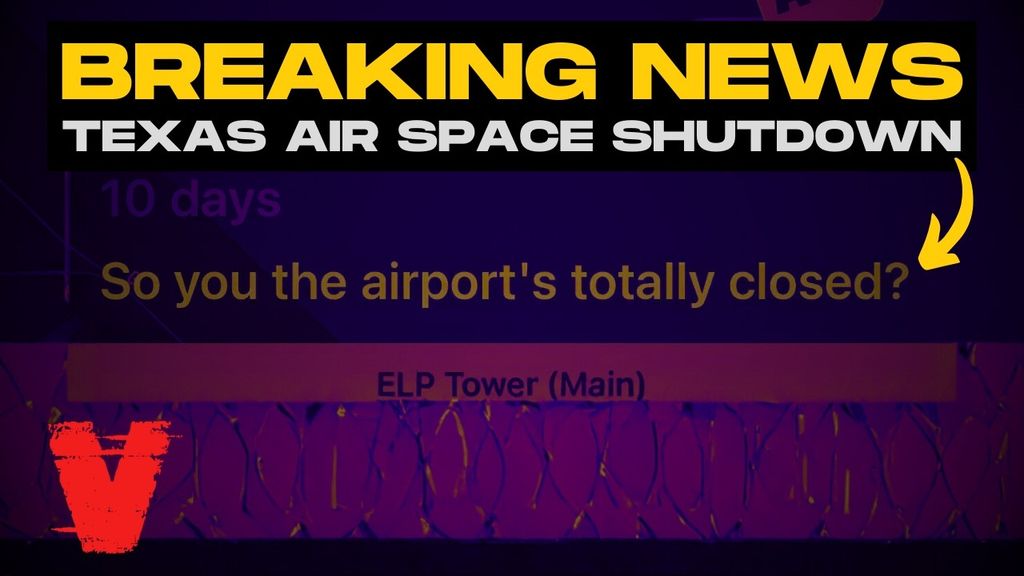
El Paso Airspace Restricted for 10 Days Under FAA ‘Special Security’ Order; Speculation Spans Border Operations to UAP


A rare, extended airspace restriction over the Texas–Mexico border has prompted intense public scrutiny and a cascade of competing explanations. According to air traffic control communications, a Temporary Flight Restriction (TFR) centered on El Paso took effect at 06:30 and will last ten days, halting all civilian air traffic. Broadcast reporting described the move as grounded in “special security reasons,” language that, combined with the duration and breadth of the action, has drawn comparisons to measures last widely seen in the aftermath of 9/11.
Operationally, the restriction appears sweeping. Controllers informed flight crews that no exceptions would be made, including for medevac operations, and that the stop was total. Reporting further cited FAA warning language that noncompliant pilots risk being intercepted, detained, and interviewed by law enforcement. Major carriers serving El Paso—Southwest, United, American, and Delta—were said to be affected. The absence of public advance notice and the immediate onset of the order have amplified questions about the underlying trigger and the parameters of the restricted area.
One focal point is proximity to Fort Bliss and Biggs Army Airfield, situated adjacent to El Paso International Airport. A post by CNN transportation reporter Pete Muntean, citing a source briefed by the FAA, attributed the TFR to military operations originating from Biggs after the Department of Defense could not guarantee civilian flight safety. If accurate, that framing implies atypical activity requiring a sterile airspace, consistent with either sustained training or real-world operations where deconfliction risks are elevated.
Analysts weighing conventional explanations have pointed to several possibilities. Border security actions against cartels, including potential strikes or interdictions, would align with the geography and could justify limited warning to avoid compromising operations. Others have suggested military testing or GPS jamming associated with nearby White Sands Missile Range; however, the length and zero-exemption posture of the restriction make routine testing a less tidy fit. Additional hypotheses—such as counter-drone measures or broader terrorism concerns—also map to the national security language that often accompanies TFRs.
UAP speculation surfaced rapidly, as it often does when authorities do not provide detailed justifications. In this case, live airport camera feeds circulating online were cited as showing unusual lights, but these were identified as fixed communications towers rather than maneuvering aerial objects. Historically, the Fort Bliss region has figured into UFO lore—from misidentified artillery flares to unverified accounts like the 1974 Coyame incident and mid-20th-century narratives involving service members—yet no evidence links the current restriction to anomalous activity. The pattern underscores a broader dynamic: in the absence of clear data, public discourse tends to fill gaps with a spectrum of interpretations, from the prosaic to the extraordinary.
The practical impacts for the region are immediate. Airlines must reroute or cancel service, cargo schedules are disrupted, and, if the no-exemption claim holds, emergency medical aviation could be constrained, placing added pressure on ground services. The scale suggests a coordinated, multi-day sequence rather than a brief, localized event.
Separately, a listener recounted a late-1980s Iowa sighting of a silent, 40–50-foot object and a contemporaneous power loss, an anecdote reflecting how personal experiences continue to inform public interest in aerial anomalies. Such accounts, while not bearing on the El Paso restriction, illustrate why transparent explanations can help stabilize discourse when unusual aviation measures occur.
Absent an official, detailed statement, the prevailing assessment remains tentative. The reported linkage to Fort Bliss operations offers a conventional explanation, yet the duration and strict enforcement posture keep attention trained on the area. Clearer public guidance from the FAA and Department of Defense would likely temper speculation and provide critical context for affected communities and operators.
Key Moments
- 00:05Air traffic control audio relays a TFR going into effect at 06:30 for 10 days, initiating a complete ground stop.
- 01:17CNN coverage is cited: the FAA closed El Paso airspace for 10 days, referencing “special security reasons.”
- 01:38Controllers state there are no exceptions, including medevac; the stop is described as total.
- 02:52A Fox News readout highlights FAA language warning noncompliant pilots may be “intercepted, detained, and interviewed.”
- 03:40One hypothesis raised: potential border security operations targeting cartels, aligned with recent rhetoric about strikes on narco-terrorists.
- 05:25Another possibility discussed: military testing or GPS jamming linked to nearby White Sands Missile Range.
- 06:28Concerns about terrorism or cross-border drone threats are considered as a prosaic security rationale.
- 10:28Pilots online characterize the scope and duration as unprecedented in their careers, drawing comparisons to post-9/11 measures.
- 10:56Live camera lights near the airport are identified as fixed communications towers, countering claims of anomalous objects.
- 12:10CNN reporter Pete Muntean’s post is cited: a source briefed by FAA attributes the ban to military operations from Biggs Army Airfield at Fort Bliss after DoD could not assure civilian flight safety.
- 13:35Historical UFO associations with Fort Bliss are reviewed, including misidentified training flares and the unverified 1974 Coyame story.
- 18:51A listener recounts a late-1980s Iowa sighting of a silent object seemingly drawing power from electrical infrastructure, illustrating enduring public interest.
Related Topics
Links & References
- Aggregated report highlighting the El Paso airspace shutdown and its unusual scope.
- CNN reporter Pete Muntean cites a source briefed by FAA attributing the restriction to operations from Biggs Army Airfield at Fort Bliss.
- UAP-focused commentary tracking developments and public reaction to the El Paso TFR.
- User-shared clips and observations related to the reported ground stop and local conditions.
- Analysis thread discussing policy and security angles behind the multi-day restriction.
- Program website with episodes and contact information for the VETTED show.
 Continue with Google