
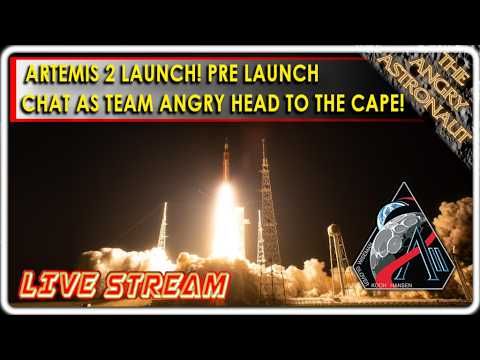
Artemis II Launches Toward the Moon: Orion Reaches Orbit, Deploys Solar Arrays, and Begins Critical Systems Checkouts


Artemis II has begun its 10‑day crewed flight test to lunar space, marking a pivotal step in NASA’s effort to return humans to the vicinity of the Moon and validate deep‑space systems for future surface operations. The mission lifted off from Launch Complex 39B at the Kennedy Space Center at 6:35 p.m. Eastern, powered by the Space Launch System’s four RS‑25 engines and two five‑segment solid rocket boosters. The ascent proceeded nominally, with solid booster separation and core‑stage main engine cutoff occurring as planned before Orion and its Interim Cryogenic Propulsion Stage (ICPS) achieved Earth orbit.
The launch culminates months of preparation and weeks of incremental readiness checks that placed particular emphasis on tanking discipline and weather risk. Tanking operations completed with all four cryogenic tanks—liquid hydrogen and liquid oxygen on both core and upper stages—reaching 100 percent and transitioning to replenish without notable leaks. Forecasts called for 80 to 90 percent favorable conditions during a two‑hour window, with brief onshore showers tracking westward. A separate range readiness concern regarding the Flight Termination System was addressed by validating signals with heritage equipment retrieved from the Vehicle Assembly Building, allowing the Eastern Range to clear the mission while SLS remained in a fully fueled configuration.
In the hours before liftoff, NASA’s crew operations unfolded in a familiar cadence: suit‑up, comm checks, and leak checks of the Orion Crew Survival Suits, followed by ingress at the pad. Commander Reid Wiseman, pilot Victor Glover, and mission specialists Christina H. Koch and Jeremy Hansen—the first Canadian to fly to lunar space—completed their procedures and verified Orion’s displays and umbilicals while closeout crews made final configurations. With the crew access arm retracted, the core stage pressurized and the launch abort system armed, ground launch sequencer software advanced the stack through a clean terminal count.
Beyond the headline liftoff, the evening’s most consequential work took place on‑orbit. Orion successfully deployed and latched all four solar array wings shortly after orbit insertion. Mission Control noted a brake indication on one wing entered an error state after appearing to settle one “tooth” during the brief perigee‑raise burn, but the array remained engaged and power‑positive. Controllers then guided Orion and ICPS into the proper burn attitude for the perigee‑raise maneuver, an approximately half‑minute RL10 engine firing that raised the orbit’s low point to set up a longer apogee‑raise burn. Updated targeting called for an apogee‑raise duration on the order of 18 minutes, a standard step to place Orion into a high Earth orbit where systems can be evaluated before the outbound trans‑lunar injection.
Communications and avionics performed largely as expected, with Mission Control Houston overseeing a brief anomaly during a handover between Tracking and Data Relay Satellites. The forward link dropped during the East‑to‑West handoff; controllers executed a ground equipment restart while the spacecraft swapped to a redundant S‑Band string, restoring two‑way voice and telemetry. During the period, the Capcom delivered updates “in the blind,” and later confirmed the crew had received them. The incident was short‑lived and did not affect vehicle guidance or planned burns.
Environmental Control and Life Support System (ECLSS) activations also began in earnest. The crew reported a blinking amber fault on the toilet unit after an otherwise nominal start, prompting a switch to contingency collection procedures while teams on the ground troubleshoot. In parallel, engineers flagged an anomalous indication on a water isolation valve between two tanks—Bravo and Charlie—during potable water distribution checks; early telemetry suggested the valve might be in a closed state. These kinds of early‑mission checkout items are expected on a first crewed flight and are handled through pre‑planned procedures and controller decision trees.
The mission plan reflects a phased approach to risk reduction. After a pair of Earth orbits and initial systems verification, Orion separates from the ICPS for a proximity operations demonstration, maneuvering near the spent upper stage using manual controls to rehearse rendezvous skills needed for later Artemis docking operations. The outbound trans‑lunar injection follows, placing Orion and its crew on a free‑return trajectory that arcs around the far side of the Moon and returns to Earth without requiring a major course‑correction burn. This profile, reminiscent of Apollo 8 and Apollo 13 in its broad geometry, provides extended deep‑space exposure for life‑support, navigation, thermal control, radiation monitoring, and crew operations—without committing to a lunar orbit insertion burn.
Radiation risk management is an explicit objective. The Sun has been notably active, and the crew will perform a scheduled “solar storm drill” to evaluate Orion’s storm shelter procedures. The vehicle’s design leverages inherent shielding near the heat shield and uses consumables such as water containers to build additional protection around the crew if needed. AstroRad vests supplement torso protection. Executing this drill in flight provides real‑world data on stowage, time‑to‑configure, human factors, and dosimetry—inputs that inform future lunar base operations and, ultimately, Mars transit mission planning where months‑long exposures and unpredictable solar particle events are a mission reality.
From a propulsion and performance perspective, the flight continues to validate SLS and Orion’s deep‑space configuration. The RS‑25 engines, repurposed from the Space Shuttle program and operating in a new four‑engine core arrangement, once again completed a full ascent duty cycle without anomaly. The ICPS’s RL10 engine executed its first burn precisely, with additional firings planned to shape Orion’s orbit and set conditions for the lunar free‑return. While public commentary often casts thrust in colorful terms, the program is focusing on measured performance data—engine chamber pressures, mixture ratios, thermal margins, and guidance dispersion—all ingredients that support confidence in recurring lunar missions.
Policy and operations also intersect in visible ways on Artemis II. The range safety challenge was resolved through a pragmatic use of certified legacy equipment and on‑console expertise, a reminder that launch operations remain a complex choreography that extends beyond the rocket and capsule. On the public side of the estuary, large crowds formed hours before launch across the Space Coast, underscoring the broad interest in milestones that expand human presence beyond low Earth orbit. Inside NASA’s control rooms, the flight director and discipline leads signaled a cautious optimism, repeatedly emphasizing contingency planning while moving the day’s timeline forward.
Scientifically, Artemis II folds in both human‑in‑the‑loop observation and technology demonstrations. The crew’s far‑side pass will offer macro‑scale views of lunar terrain from greater distances than Apollo’s low‑lunar orbits, enabling context imagery that complements high‑resolution robotic maps. Orion carries internal and external cameras for engineering documentation and public outreach, and mission specialists will operate biomedical and technology payloads that trace how spaceflight affects human physiology, materials, and instrumentation performance. Meanwhile, ground‑based lunar initiatives continue through NASA’s commercial lander partnerships and international collaborations, positioning science to benefit in parallel with flight test objectives.
Looking ahead, Artemis II is designed to answer a specific set of questions: Can Orion’s life‑support, power, and guidance systems sustain four people for the round‑trip to lunar space? Do comms, navigation, and flight dynamics behave as modeled across burns, handovers, and thermal regimes? Can manual piloting and close‑proximity operations be executed with the required precision? The answers inform the next phase—Earth‑orbit docking practice with Human Landing System vehicles and, thereafter, a return to the lunar surface. The deliberate layering of test points illustrates a mission architecture that prizes incremental verification over headline‑grabbing leaps.
The broader conversation around exploration also surfaced adjacent themes. Observers highlighted the scientific value of a radio‑quiet observatory on the Moon’s far side for deep‑space listening and SETI work, given the insulation from terrestrial interference. There was also passing discussion of speculative propulsion concepts, such as magnetohydrodynamic systems sometimes invoked in UFO debates. While those ideas remain outside mainstream engineering practice, Artemis’s methodical approach to radiation, propulsion, and human‑systems integration addresses the same core challenge that fuels such speculation: building reliable, scalable means for sustained operations beyond Earth.
By the end of launch day, Artemis II had cleared its early gates: a clean ascent, solid upper‑stage performance, arrays generating power, and a successful initial orbit‑raising burn. Controllers were troubleshooting a handful of on‑board systems indications while the capsule proceeded through a thermal roll and set up for the longer apogee‑raise burn. The mission’s central work—verifying that the spacecraft, crew procedures, and ground systems collectively support safe, repeatable voyages to the Moon—has now moved from planning into practice, one measured milestone at a time.
Key Moments
- 01:16:13Weather outlook set at approximately 80% favorable for launch; propellant loading reported nominal with no significant hydrogen leaks during tanking.
- 01:23:28Artemis mission sequencing explained: Artemis III reshaped into an Earth‑orbit docking practice with Human Landing System vehicles before a first landing now targeted for Artemis IV.
- 01:31:59Solar storm considerations discussed; Orion’s radiation shelter and crew AstroRad vests highlighted, with a planned in-flight solar storm drill to validate procedures.
- 01:58:33Vehicle performance context: four RS‑25 engines and twin solid rocket boosters described; engines are heritage Space Shuttle units refurbished for SLS.
- 02:05:49Artemis II trajectory outlined: multiple Earth orbits, separation from ICPS, a proximity-operations demo near the upper stage, then trans‑lunar injection into a free‑return path.
- 02:37:48NASA coverage shows crew suit-up and leak checks for Commander Reid Wiseman, Pilot Victor Glover, and Mission Specialists Christina H. Koch and Jeremy Hansen.
- 02:41:47Tanking complete and all stages in replenish; roughly 733,000 gallons of cryogenic propellants aboard with no leak constraints reported.
- 05:01:48Broader context touchpoint: discussion of exotic propulsion concepts, including magnetohydrodynamic drive as a speculative explanation for UFO performance, and the value of a radio‑quiet far‑side lunar observatory for SETI.
- 06:03:32Eastern Range reports a Flight Termination System verification issue; NASA approves use of heritage VAB equipment to validate range signals, later resolving the constraint.
- 07:59:28Terminal count begins at T‑10 minutes after a short hold; crew access arm retracts, core stage pressurizes, and launch abort system is armed.
- 08:09:14Liftoff: SLS clears the tower at 6:35:12 p.m. Eastern; solid rocket booster separation follows cleanly as Orion ascends on a nominal trajectory.
- 08:17:13Main engine cutoff and core‑stage separation confirmed; Orion and the ICPS upper stage achieve Earth orbit en route to a lunar free‑return.
- 08:33:20All four Orion solar array wings deploy and latch; a brake sensor on one wing flags an error but remains functionally engaged.
- 08:58:28Perigee‑raise maneuver (PRM) completed; a short RL10 burn increases the orbit’s low point to set up the longer apogee‑raise burn that will place Orion in high Earth orbit.
- 09:10:48Communications handover from TDRS East to West produces a temporary forward‑link issue; ground resets and on‑board string swap restore two‑way comms.
- 09:24:06Early ECLSS checkouts: crew reports a blinking fault on the toilet unit and a water‑isolation valve anomaly between tanks Bravo and Charlie; controllers direct use of contingency procedures while troubleshooting.
 Continue with Google