
MK Ultra Dispute, Secret UAP Programs and Reptilian Symbolism Drive a ‘Weird Week’ of Disclosure Debate


A recent episode of the Polarity channel’s “Weird Week” survey stitched together multiple storylines that sit at the intersection of UAPs, mind control allegations, classified physics, and esoteric symbolism. Host Josh framed the week’s developments as part of an emerging pattern: institutions and media producing a steady stream of anomalies, disclosures and reversals that both demand scrutiny and risk functioning as a form of low-level societal conditioning.
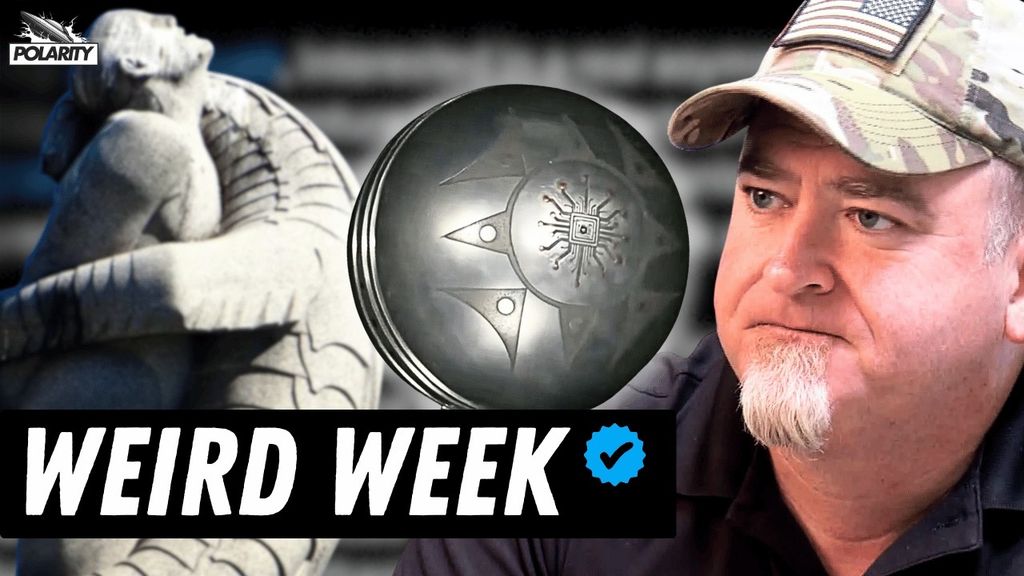
The program opened with a revisit to Latin American “mystery objects,” focusing on a newly publicized metallic sphere presented by Mexican journalist Jaime Maussan. This so‑called Valdivia sphere, reportedly recovered from jungle terrain in Colombia after an elderly couple saw a glowing orb descend from the sky, closely resembles the earlier Bogotá or “Buga” sphere. As with its predecessor, observers quickly noted hand-etched markings and non-precision machining inconsistent with expectations of non-human fabrication. Josh acknowledged those criticisms but suggested that public debate has tended to polarize prematurely between “alien artifact” and “simple hoax,” skipping over a third possibility: that such devices, if genuine, could represent a compartmentalized, human-origin technology rooted in a classified branch of physics.
That line of thought drew on commentary from figures like Hal Puthoff and Eric Weinstein, who have both publicly alleged the existence of physics and engineering work sequestered within government and defense contractors and never shared with the wider scientific community. Josh argued that, if real, objects like the Bogotá and Valdivia spheres fit more naturally into a scenario of black-budget esoteric technology than one of stray extraterrestrial probes. In that framing, hand‑worked surfaces and imperfect lines might reflect human manufacture within a closed compartment rather than amateur fakery or alien craftsmanship.
From there, he emphasized how culture shapes interpretation. The Colombian witness reportedly labeled the sphere “witchcraft,” which he contrasted with likely reactions in different locales: a desert town in Arizona might default to “aliens under Secret Mountain,” while a small Catholic village in Italy could frame the same event as divine or demonic intervention. The object is constant; the interpretive lens varies. For Josh, this highlighted a recurring problem in anomalous phenomena: experiences are filtered through religious, folkloric or conspiratorial frameworks long before they reach investigators or the public.
The episode then shifted sharply to Washington, where an anticipated congressional hearing on MK Ultra was postponed at the last moment. Representative Anna Paulina Luna had planned a session modeled loosely on recent UAP hearings to explore legacy mind-control and trauma-based experimentation programs. On the morning of the hearing, three of four scheduled witnesses withdrew, citing safety concerns. Luna publicly stated that only one witness had remained willing to testify, and promised a new date.
Josh contrasted this last‑minute collapse with the visible pool of self-described victims and survivors volunteering to appear. Under posts about the postponement, numerous individuals, including podcaster Emma Katherine and long-time whistleblower Fiona Barnett, reiterated their willingness to testify about MK Ultra, Monarch and related programs. He questioned how, given this apparent pool of eager witnesses, the hearing could have been built around three individuals who would pull out on the day, and floated the possibility that some “witnesses” might be positioned to delay or derail accountability processes rather than advance them.
That suspicion was reinforced, in his view, by Luna’s subsequent public confrontation with the CIA over records. In a televised statement, the congresswoman accused CIA personnel of quietly seizing files related to JFK and MK Ultra that had previously been denied or declared non-existent, and warned that any officials who destroyed or withheld documents against a presidential executive order would face criminal consequences. She called on those holding the records to return them within 24 hours and announced that her office would send formal preservation notices.
Josh’s unease centered less on the substance of the accusations and more on the way the confrontation unfolded in public. He noted that Luna’s social media posts tagged the CIA directly and used language (“punitive action incoming,” “return the documents”) that read more like a broadcasted ultimatum than an internal oversight communication. Together with public travel updates from Representative Eric Burlison about a rapid trip to CIA headquarters to “deliver a message,” he argued this dynamic resembled “kayfabe”: staged conflict that dramatizes institutional struggle in front of the audience.
He proposed that whether these clashes are fully genuine, partially performative, or something in between, their net effect may be similar: the public is fed a continuous diet of crisis and institutional dysfunction. Combined with other ongoing storylines—the Epstein files, warnings of “interdimensional threats,” and now renewed MK Ultra discourse—this can accumulate as a kind of “drip-fed trauma,” keeping populations anxious and malleable. He connected this idea to MK Ultra’s documented reliance on trauma to alter perception and compliance, suggesting that contemporary information flows may represent a less overt but still powerful form of environmental conditioning.
The MK Ultra segment deepened when former CIA officer Sarah Adams weighed in on social media to claim that MK Ultra “did not work” and had been ended, and that popular accounts overstate its capabilities. Her comments triggered strong reactions from survivors and advocates. Kathy O’Brien, whose testimony Josh has covered previously, responded that MK Ultra’s core formula—trauma coupled with sleep, food and water deprivation, and structured abuse—is a versatile tool for both individual and societal manipulation. She tied its origins to Project Paperclip, asserting that know-how from Nazi research migrated into U.S. intelligence and NASA-linked programs.
Josh did not attempt to adjudicate all historical claims but highlighted the asymmetry between Adams’ dismissive framing and the volume and consistency of survivor accounts. He also underscored that Adams’ own CIA background makes her categorical assurances—“it was fake” or ineffective—especially controversial, given that key MK Ultra records were destroyed and that the full extent of successor programs has not been declassified.
From contested mind-control history, the show moved back into contemporary UAP testimony. At a recent panel with Jeremy Corbell and George Knapp, Air Force veteran Dylan Bolland recounted his now-well-known claim of seeing a bright orb near a NASA hangar at Langley Air Force Base around which a triangular craft materialized. Bolland emphasized that when he and other whistleblowers testified in secure facilities, AARO did not exercise its own original classification authority over this triangle; instead, the relevant agencies declined to classify it as sensitive U.S. technology. He took this as strong evidence that the craft was “not ours,” at least not within acknowledged military inventories.
Josh cautioned against jumping straight from “not ours” to “extraterrestrial.” He instead revived a hypothesis associated with researchers like Richard Dolan: that a very small, well-funded human group—often dubbed a “breakaway civilization”—may control advanced propulsion and energy technologies outside conventional military and governmental oversight. In this model, such a group could develop vehicles with performance matching reported UAPs, exploit trillions of missing or unaccounted public dollars, and use this technological edge to maintain global influence while keeping the broader population tied to fossil-fuel economies and wage labor.
This argument dovetailed with a separate clip featuring film producer Dan Farah discussing the Tic Tac incident with Hal Puthoff present. Farah underscored the staggering energy requirements implied by a craft jumping from near sea level to roughly 80,000 feet repeatedly in short intervals, suggesting no documented human power source could support such maneuvers. Josh pointed out that this conclusion assumes “caveman” propulsion—linear acceleration within classical aerodynamics. If, as multiple physicists and remote viewers have proposed, some UAPs manipulate spacetime, bend local gravity or transit through wormhole-like structures, the required energy profile and engineering approach could differ radically from standard aerospace engineering.
To illustrate that conceptual shift, he played a notable story from former Army remote viewing chief Skip Atwater. In Atwater’s account, he found himself in a small craft behind a non-human being that explained faster-than-light travel using a Rubik’s cube analogy. Each tile of the cube, Atwater was told, corresponded to a periodic table of elements; by “twisting” the cube so that the elemental configuration at the craft’s location matched a distant configuration (e.g., Alpha Centauri), the craft effectively appeared at the new location without traversing the intervening space. Josh interpreted this as a metaphor for altering environmental parameters—perhaps frequency, field geometry or spacetime curvature—rather than accelerating an object through vacuum.
He then linked this narrative to comments by Tom DeLonge, who has argued that time is best understood as a set of parallel frequencies. In DeLonge’s description, a sufficiently advanced civilization might construct a “submarine” that changes voltage or frequency to move laterally across timelines at the same spatial coordinates. Josh suggested that if time is indeed layered rather than linear, phenomena such as the Mandela effect, persistent reports of oddly “out-of-time” artifacts, and UAPs that appear or disappear instantaneously could all reflect small-scale interactions with adjacent temporal layers.
This led naturally into the most speculative part of the broadcast: John Ramirez’s claims about human origins and hybridization. Ramirez, a retired CIA officer, has previously asserted that U.S. intelligence discovered after World War II that humans are hybrids, with some family lines more highly “enhanced” than others. In the material Josh replayed, Ramirez reiterated that intelligence agencies can classify DNA-related operations and that aerospace corporations hold proprietary physics data insulated from FOIA via intellectual property protections—points backed by Puthoff in the same discussion.
Ramirez described being told that all humans carry hybrid characteristics to some degree, but that certain “ancient families” show stronger signatures and receive particular attention. He also cited Lou Elizondo’s remark that around 70,000 years ago “something fundamentally changed” in the human line, and that understanding UAP fully requires understanding what was altered and why. Elizondo, in an earlier monologue Josh regards as his most candid, urged listeners to consider the possibility that core teaching about human history, identity and our position in the cosmos might be incomplete or incorrect.
In a more recent interview played on the show, Elizondo returned to that introspective tone but shifted from ontological speculation to practical advice. He argued that disclosure—whether of UAP origins, advanced technologies or hybridization—will proceed regardless of public readiness. His guidance was to focus less on chasing every data point and more on strengthening personal relationships and character: spend time with children, know their lives as well as one knows sports statistics, reconcile with family where possible, and cultivate patience and compassion. For Elizondo, meaningful engagement with whatever “is out there” begins with a clear view of “what is in here,” in individual hearts and communities.
Josh endorsed this perspective, adding that his own recent psychedelic experience reinforced the same conclusion: that when systemic shocks come—whether technological, political or ontological—people’s real safety net is not their entertainment, news feeds or even their specific beliefs about UAP, but the reliability and love of those closest to them.
The episode then turned back toward symbolism in the physical environment, focusing on Norway’s Vigeland Sculpture Park in Oslo. Drawing on images circulating online, Josh described several of Gustav Vigeland’s granite and bronze works: nude adult figures grappling with lizard-like creatures wrapping around their bodies and necks; a doorway framed by reptilian forms; a monumental pillar of intertwined human bodies; and multiple nude child figures, sometimes clustered, sometimes in positions that read as vulnerable or distressed.
Official cultural descriptions, which Josh read aloud, present these pieces as allegories of “the complex duality of the human condition,” depicting internal struggles, primal instincts and subconscious battles. Google’s summary explicitly cautions against “conspiracy theories” and interprets the reptilian-human sculptures as psychological symbolism rather than literal monsters. Josh acknowledged that reading but questioned the curatorial decision to anchor a flagship public park with so many depictions blending humans, reptiles and children in ways many visitors find unsettling.
He contrasted the official “inner duality” framing with interpretations informed by David Icke and others who discuss reptilian entities as lower-dimensional attachments feeding on fear, sexual energy and domination. In that context, a statue of a reptile constricting a human whose wrists are pinned, or a doorway ringed in carved lizards and infant heads, may also be read as encoded commentary on unseen influences over human behavior. Whether or not one accepts literal reptilian entities, Josh suggested that the imagery’s focus on domination and vulnerability is difficult to reconcile with the idea of a neutral civic environment, particularly given its accessibility to children.
As the broadcast approached its close, Josh briefly highlighted a social media post by Representative Eric Burlison that used a meme format from The Truman Show, casting the film’s mysterious director as a stand‑in for unseen orchestrators. Burlison captioned it, “Send in the bees,” a reference that prompted researcher Ree Dalt Morgan to note the role of bees in The X-Files as vectors for a genetically tweaked alien virus used in population control plots. Josh connected this to recent chatter about real-world pathogens with long asymptomatic windows on cruise ships and elsewhere, and argued that fiction, viral memes and emerging news stories often interlock in ways that shape public expectations long before major announcements or crises.
Across its two-hour runtime, the “Weird Week” episode did not produce definitive answers about MK Ultra, Rubik’s Cube‑branded programs, or reptilian statues. Instead, it mapped the way a certain segment of the informed public is processing these signals: as overlapping patterns of secrecy, symbolism, trauma and technological disparity that could bear directly on how any near-term UAP disclosure is framed and received. Josh’s concluding message echoed Elizondo: amid escalating strangeness, the most constructive response may be to remain informed but grounded—building resilient relationships and critical thinking, even as one tracks spheres in jungles, hearings in Washington and lizards carved in stone.
Key Moments
- 03:39Mexican journalist Jaime Maussan promotes a newly recovered metallic 'Valdivia sphere' found in the Colombian jungle, closely resembling the earlier 'Bogotá sphere,' prompting debate over whether such artifacts are hoaxes, black-budget technology, or something non-human.
- 05:05Josh argues that witnesses interpret anomalous objects like orbs through their cultural lens—witchcraft in parts of South America, aliens in the U.S. Southwest, or religious signs in Europe—complicating efforts to reach objective conclusions.
- 06:54He raises the possibility that some crafted spheres and similar objects, even if not alien, could represent a compartmentalized, classified branch of human physics and technology described by figures such as Hal Puthoff and Eric Weinstein.
- 18:40A planned congressional hearing on MK Ultra spearheaded by Rep. Anna Paulina Luna is abruptly postponed after three out of four witnesses withdraw on the day, despite many self-described survivors publicly volunteering to testify.
- 23:48Luna publicly accuses CIA personnel of removing and hiding files related to JFK and MK Ultra in defiance of an executive order, threatening criminal accountability and demanding the documents’ return within 24 hours.
- 26:50Josh questions why these confrontations between Congress and the CIA are playing out on social media and cable news, suggesting they resemble scripted 'kayfabe' while also potentially serving as low-level, drip-fed societal trauma.
- 31:54Former CIA officer Sarah Adams states on X that MK Ultra 'did not work' and was terminated, prompting strong pushback from survivors like Kathy O’Brien, who reiterates that trauma-based mind control protocols trace back to Project Paperclip and have ongoing implications.
- 38:49UAP witness and former Air Force servicemember Dylan Bolland describes a glowing orb near a NASA hangar that a triangular craft appears around before departing, and notes that AARO chose not to classify this triangle, which he interprets as evidence it is 'not ours.'
- 45:34In a live event recorded by Neandrewth, journalist Jeremy Corbell presses Bolland about a rumored program called 'Project Rubik’s Cube'; Bolland refuses to confirm or deny testimony about it and calls on the government to grant formal whistleblower amnesty.
- 50:50Former Army remote-viewing lead Skip Atwater recounts an encounter in which a non-human intelligence uses the metaphor of a Rubik’s cube whose elemental tiles are 'twisted' to shift locations, as an analogy for interstellar travel and spacetime manipulation.
- 56:41Researcher Tom DeLonge outlines a model in which time is parallel rather than linear, suggesting advanced civilizations can shift their craft’s 'voltage' to move between timelines, a concept Josh links to wormhole-like travel and potential explanations for UAP performance and Mandela-effect memories.
- 01:07:27Ex-CIA officer John Ramirez and colleagues, including Hal Puthoff, discuss classified human DNA research and assert that aerospace corporations hold proprietary, FOIA-exempt physics data, while Ramirez claims U.S. intelligence learned after World War II that humans are hybrids with some families more 'enhanced' than others.
- 01:15:58Former AATIP director Luis Elizondo delivers a somber reflection that humanity may have misunderstood its own origins and place in the universe, hinting at a genetic 'enhancement' roughly 70,000 years ago and urging people to prioritize family, compassion and inner reflection as disclosure advances.
- 01:32:32Josh examines Norway’s Vigeland Sculpture Park, focusing on statues of humans entwined with reptilian creatures and large nude child figures, and contrasts official explanations about 'inner duality' with interpretations that see them as elite or esoteric symbolism about reptilian control.
- 01:37:12He closes by highlighting memetic links between John Travolta’s stylized public appearance, X-Files storylines about bees carrying engineered alien viruses, and current chatter about novel pathogens, arguing that film, symbolism and staged narratives may precondition the public for coming disclosure events.
Related Topics
Links & References
- Polarity Josh’s Twitch channel where the show is simulcast and post‑YouTube discussion continues.
- Polarity2.0 YouTube channel for clips and highlights related to the main Polarity content.
- Polarity community Discord server where viewers discuss UAP, MK Ultra, symbolism and related topics.
- Polarity merchandise store featuring clothing and other items for the channel’s audience.
- Buy Me a Coffee page for financially supporting the Polarity channel.
 Continue with Google