
Trump UFO Disclosure Efforts, Crash Retrieval Briefings, And Community Rift Over Lue Elizondo


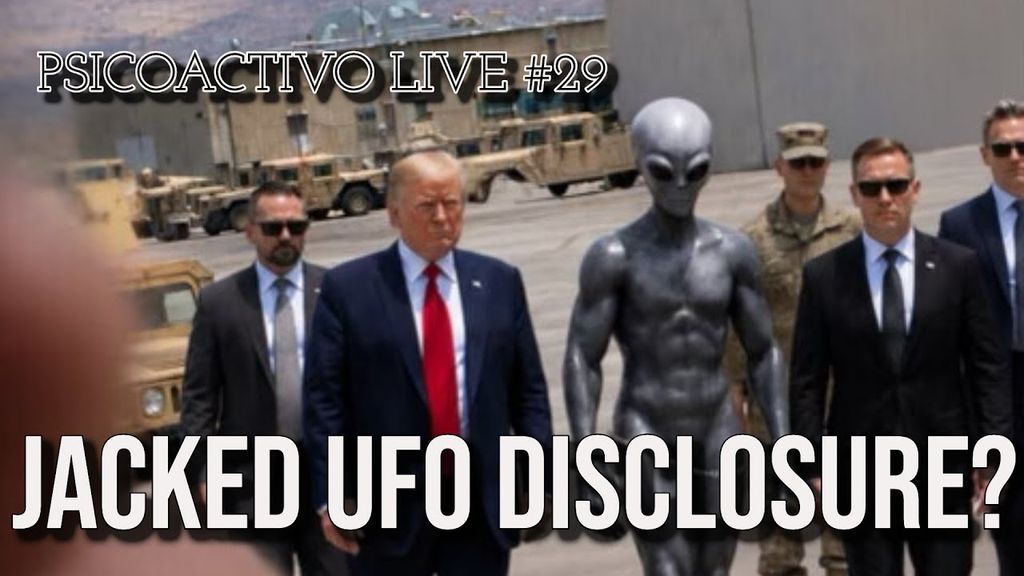
Donald Trump’s recent Truth Social post depicting himself walking with a muscular Grey alien has become a focal point for ongoing efforts to pull the former president directly into UFO disclosure politics. For host and journalist Pavel Ibarrameda, the post is not just internet trolling; it appears against a backdrop of escalating public engagement with official UAP material, renewed claims that Trump is being briefed on crash retrieval programs, and carefully laid plans by disclosure advocates who want Trump to deliver a structured acknowledgment that “we are not alone.”
Trump’s UFO imagery and the war.gov surge
Pavel connects Trump’s Truth Social alien post directly to the performance of the war.gov UAP release site, which he says has accumulated around one billion views in a little over a week. That level of traffic, he argues, is precisely the type of metric that captures Trump’s attention: high visibility, viral interest, and direct proof that the topic drives clicks and conversation. Against that numerical backdrop, the alien image begins to look less like a random joke and more like Trump sampling a theme that is already delivering enormous engagement to a government‑branded platform.
The underlying image, Pavel notes, is an AI‑generated still derived from an obvious AI video that circulated previously. Trump simply reposted a higher‑resolution adaptation. The post itself is real, hosted on his official Truth Social account; the image is not. Even so, Pavel says the episode “escalated things pretty quickly,” because it arrived just as multiple insiders have been trying to get Trump more deeply involved in UFO disclosure planning.
A disclosure task force vision built around Trump
Central to Pavel’s framing is an audio clip from activist Brett Tingley Federson, recorded during a “Nature of Disclosure” Q&A session in November. Federson, a close associate of Dan Farah, outlines a detailed scenario in which a President Trump publicly acknowledges UAP reality and then announces a formal “disclosure task force.” In Federson’s conception, the task force would review “mounds” of classified UAP data and release information gradually, in a curated sequence structured so the “story makes sense” to the public.
Federson stresses that an indiscriminate data dump would leave the world trying to interpret reams of archives for decades. Instead, he argues for a process in which the president is frank about longstanding awareness and study of UAP, admits that there is still a long way to go, and emphasizes that Americans can “handle the truth” but not continued deception. He also frames disclosure as a time‑sensitive competition with Russia and China over reverse‑engineering anomalous technologies, suggesting that the United States should “lead the effort.”
Pavel interprets this as evidence that by late 2024 a small circle around Farah and Federson saw Trump as a potential central figure in a structured disclosure rollout. He says his own reporting since November has consistently pointed to people near Farah believing Trump’s desk was receiving UAP‑related material, even if he was not yet fully briefed on legacy crash retrieval programs.
Competing accounts of Trump’s UAP briefings
The question of exactly what Trump has been told is now at the heart of a dispute among high‑profile insiders. Pavel recounts a recent LinkedIn post by astrophysicist and consultant Eric Davis, who states that it was Jay Stratton and Travis Taylor who briefed Trump on UAP during his first administration. According to Davis, that briefing explicitly excluded legacy crash retrieval programs, which he describes as having hidden themselves from executive and legislative oversight via financial fraud and misappropriated authorities.
Davis argues that this covert structure contradicts any claim that Trump was fully briefed on the crash retrieval effort, and suggests that whistleblower David Grusch “misspoke” when he said Trump had been read into legacy programs. Grusch previously served as NRO liaison to Stratton’s UAP Task Force, and Davis says that as Stratton’s science advisor he is better positioned to know what was, and was not, in the official brief.
Journalist Ross Coulthart publicly contests that view. In a post highlighted by Pavel, Coulthart says he is “told” that the president of the United States — Trump — is now briefed on the legacy UAP crash retrieval program. Coulthart credits Trump, Sen. Marco Rubio, Rep. Anna Paulina Luna, Rep. Eric Burlison, and Rep. Tim Burchett for pushing hard for answers that earlier administrations did not obtain. Coulthart adds that Trump now “knows much more” than what was contained in the original UAP Task Force brief sent to the White House in his first term.
Pavel sides with Coulthart’s assessment, arguing that Coulthart is currently better wired into active disclosure negotiations than Davis. He points to a pattern in which Davis has issued pessimistic or inaccurate predictions about hearings and internal developments. In contrast, Coulthart’s claim that Trump is now read into legacy programs aligns with what Pavel has been hearing from his own sources: that congressional advocates, cabinet‑level staff, and people close to the White House have increased their direct information flow to Trump.
Classified briefings and a gasped‑at UAP video
The emerging congressional role is underscored by comments from Rep. Eric Burlison, who has spoken about a classified UAP video shown in a secure compartmented information facility (SCIF). According to Burlison, everyone in the room — including prior skeptics — audibly gasped when they saw the footage. Pavel says that description has become a benchmark for what lawmakers consider genuinely extraordinary UAP evidence, though he notes that it is unclear whether that specific video will appear in the first tranche of public war.gov releases.
Burlison has also said that the White House contacted him directly to co‑lead on UAP efforts alongside Luna and Burchett, in part because of their sustained work on the issue. Pavel interprets this as confirmation that the congressional trio most closely associated with aggressive UAP oversight is now in more direct contact with the executive branch, feeding information up as well as demanding it down.
Burchett, for his part, remains publicly wary. In a separate interview Pavel plays, the Tennessee congressman accuses the “deep state” and “alphabet agencies” of slow‑walking UAP files despite Trump keeping his word to him on specific transparency commitments. Burchett suggests that part of the reluctance stems from the need to admit to decades of lying, and he speculates that zero‑point or “free energy” concepts and other classified technologies may be wrapped up in the withheld material. He doubts the public will ever see “everything we have,” but says Trump has so far honored promises made directly to him.
Trump, China, and a possible technology arms race
Pavel raises a speculative but pointed question about Trump’s reported recent trip to China with a delegation of prominent U.S. tech billionaires. If Ross Coulthart is correct that Trump has now been briefed on a legacy crash retrieval program, Pavel asks whether advanced technologies, potential reverse‑engineering, or an arms race dynamic could have formed part of the behind‑closed‑doors discussion between Trump and President Xi Jinping.
He notes that the trip was followed closely by Trump’s Grey‑alien post and asks his audience whether they think UAP technology, alleged “free energy,” or reverse‑engineering issues were on the table in Beijing. While he stops short of asserting any direct link, he frames the scenario as at least strategically plausible if both Washington and Beijing perceive an opportunity or threat in exotic propulsion or energy systems.
Frustration over imagery quality and expectations for war.gov
Audience questions repeatedly return to dissatisfaction with “grainy footage” and the hope that upcoming drops will finally include clear, multi‑sensor, high‑resolution evidence. Pavel acknowledges the frustration, citing the recent interview clash between comedian Chris Ramsey and filmmaker Jeremy Corbell as an expression of broader impatience inside the UAP community. He notes Corbell’s reference to alleged 4K, multi‑sensor UAP recordings and says he hopes such material exists and is eventually released, while doubting that the most sensitive files will appear in early batches.
From Pavel’s sources, the war.gov releases are expected to continue every two weeks, with roughly 200 items per drop. The next wave, he says, should include more than 40 specific videos that Rep. Anna Paulina Luna formally requested by title. He underscores that while documents, photos, and other artifacts may also appear, credible, well‑documented video — with full metadata and independent analysis — is likely to be the threshold for convincing the broader public.
Lue Elizondo, AAWSAP, AATIP and a ‘silly tiff’ with real consequences
Beyond Trump, war.gov and crash retrieval briefings, the episode devotes significant time to Lue Elizondo’s contested role in the Pentagon’s UAP work. Pavel plays a segment from Ross Coulthart’s “Reality Check” program in which Coulthart is asked to comment on DIA analyst James Lacatski’s remarks about disinformation from some congressional UAP witnesses.
Lacatski, who directed the Defense Intelligence Agency’s Advanced Aerospace Weapon System Applications Program (AAWSAP, sometimes called “ORAP” in the transcript), suggested on Jeremy Corbell and George Knapp’s “Weaponized” show that some testimony to Congress misrepresented the relationship between AAWSAP and the later Advanced Aerospace Threat Identification Program (AATIP). While he did not publicly name individuals, community analysis has consistently linked his criticism to Elizondo’s description of AATIP’s scope and status.
Coulthart says he does not understand why Lacatski continues to make veiled accusations without specificity, nor why Elizondo has not offered a clear, publicly documented reconciliation of AAWSAP and AATIP’s relationship. Coulthart hints that Elizondo’s true position as a Department of Defense counterintelligence officer and any involvement with a “legacy” retrieval program are sensitive and likely constrained by classification. He suggests that, eventually, Elizondo will have to provide a “clearer accounting” of his precise role — both in the informal AATIP continuation and in relation to any crash retrieval program.
According to Coulthart, national security constraints currently prevent several individuals from fully explaining their roles. He posits that, following the 2016 Clinton–Trump election, a faction within the Pentagon and intelligence community created To The Stars Academy and promoted figures like Jim Semivan and Elizondo as the public face of a managed disclosure initiative. While he calls that effort “laudable and genuine,” he also entertains the possibility that it was designed to shape and control the narrative.
Coulthart concludes that the continuing conflict between Lacatski and Elizondo — and between their respective supporters — is “very unhealthy” for UAP discourse. Pavel echoes that assessment, noting that social media debates around Elizondo have become so toxic that he stepped away from some online spaces. He says he does not trust Elizondo personally but distinguishes that from character attacks, urging that similar scrutiny be applied to other prominent figures such as Steven Greer, whom he sees as equally intent on dominating the narrative.
Ignored questions: John Burroughs, injuries, and smoking‑gun documents
Pavel highlights one specific instance in which he believes critical evidence is being sidelined. Rendlesham Forest witness John Burroughs recently appeared on his program to discuss his new book and to display portions of official documentation establishing that he was injured in the line of duty during the 1980 Rendlesham incident and that he subsequently received disability benefits tied to that exposure.
According to Pavel, Burroughs is one of only two former service members currently recognized as having been injured by a UAP event and compensated accordingly. For Pavel, that combination — documented injury, official acknowledgment, and a long‑studied UAP incident — constitutes what many have long described as “smoking gun” evidence. Yet he says Burroughs’ story is being ignored by news outlets and influencers most associated with disclosure.
He recounts that when the “Age of Disclosure” film was in production, producers wanted Burroughs to serve as the documentary’s key evidentiary linchpin, but Burroughs refused participation. Pavel now sees major platforms such as NewsNation and high‑profile interviewers like Jesse Michels passing over Burroughs, even after Pavel tried to connect them. He speculates that some insiders are interested only in extracting Burroughs’ documents without giving him a chance to tell his full story, including his theory that directed‑energy or other classified technologies may have been deployed during the Rendlesham events.
In light of this, Pavel submitted a question to Elizondo during a recent X (Twitter) Q&A, asking why “people at the top of the disclosure movement” are ignoring Burroughs when he holds official documentation linking his disability to the UAP incident. The question attracted support from other users but went unanswered. Pavel says he understands Elizondo faced hundreds of questions, yet he regards the silence on Burroughs as symptomatic of a broader pattern in which veterans’ health and injury claims tied to UAP exposure are downplayed.
For Pavel, this ties into a larger under‑reported issue: a cluster of aging Area 51 veterans and others who worked around sensitive facilities and subsequently developed cancers or other ailments. He argues that if disclosure proponents truly want compelling, verifiable cases, then documented UAP‑related injuries and illnesses should be at the forefront, not on the margins.
Greer, Maussan, and the problem of certainty
The livestream also touches on high‑profile personalities whose certainty about the nature of UAP and related phenomena makes Pavel uneasy. He says he does not “mess” with figures like Steven Greer or Jaime Maussan, criticizing Greer’s tendency to claim comprehensive knowledge of the entire UAP picture and Maussan’s long record of promoting cases that later unraveled as hoaxes.
Pavel recounts that after he publicly discussed Maussan’s track record on another channel, Maussan phoned him and tried to dictate what he should and should not say. Pavel refused, pointing out that he does not work for Maussan and that documented hoaxes are a matter of public record. He draws a parallel to Greer, saying he is wary of any disclosure leader who claims definitive explanations for all aspects of the phenomenon while also trying to steer the entire field.
Experiencers, channeling claims, and the limits of lore
Beyond formal programs and media personalities, Pavel engages viewers on claims of telepathy, channeling and “hierarchies of beings.” He notes that some intelligence and military circles reportedly believe they are in contact with non‑human entities through channeling and that this belief may contribute to a sense of superiority over the general population. He mentions allegations that unnamed generals are currently participating in sessions intended to communicate with such entities.
Even so, Pavel treats this material as “lore” until substantiated. He emphasizes that while he respects the sincerity of experiencers — including those who report ongoing telepathic contact with orbs or entities over decades — he is unwilling to accept elaborate taxonomies of alien species, angels, or demons without concrete evidence. For him, personal accounts matter as data points about consciousness and subjective experience, but they do not automatically validate detailed cosmologies.
Paradigm shifts, free energy and who benefits
One of the more philosophically charged segments involves a viewer comment that Trump and China might coordinate to retain control when “free energy” emerges. This prompts Pavel to question whether leading scientists and technologists in the disclosure world — he names Kit Green, Garry Nolan and Jacques Vallée — have fully considered the societal implications of any genuine release of revolutionary energy or propulsion technologies.
He argues that many pro‑disclosure scientists and entrepreneurs continue to operate within a “materialistic, capitalist, money‑based, consumer‑based paradigm,” expecting a technological boom that will benefit their companies or sectors. Pavel contends that genuine disclosure of transformative technologies should, in principle, end that paradigm or at least radically rebalance it toward universal abundance.
However, he doubts that either “controlled disclosure” advocates or entrenched elites are prepared to accept such a shift. He suggests that if advanced technologies are real and connected to UAP, current power structures will likely seek to preserve the petro‑dollar and global capitalist systems, even if that means engineering a rollout that continues to favor those already living in abundance. Pavel invites his audience to consider how a more equitable transition could be managed without catastrophic economic collapse, acknowledging that any paradigm change would challenge existing financial and political frameworks.
Evidence thresholds and public attention spans
When asked what would “honestly” satisfy the average person that non‑human intelligence exists, Pavel outlines several potential thresholds. The first is a well‑sourced, high‑resolution, Independence Day–style video of a craft at close range, backed by verified metadata and corroboration from multiple independent analysts. The second would be physical bodies or a live non‑human entity presented transparently. A third pathway would be a robust scientific or archaeological announcement from mainstream institutions, demonstrating unmistakable non‑human origins.
He also acknowledges the hypothetical of a global mass sighting that becomes impossible to ignore. Yet he is skeptical this will occur and, more importantly, warns that modern short attention spans could blunt even dramatic evidence. In an age where “we have the attention span of a squirrel,” he says, major revelations may only command public focus if they directly affect people’s finances, safety, or families. Unless disclosure delivers immediate, tangible impacts on daily life, many may briefly be fascinated and then return to routine concerns.
International moves and the pace of disclosure
Pavel briefly corrects a viewer who assumed Japan and China have already released significant UAP documents. He notes that Japanese officials have recently said they are monitoring U.S. developments and taking UAP more seriously but have not published major dossiers. He mentions that a Japanese lawmaker, likely Yoshiharu Asakawa, has contacted Elizondo, and that some form of meeting between Japanese and American advocates may be in the works.
On the U.S. side, Pavel believes internal dynamics within legacy programs and government compartments are shifting. He suggests that recent exposure of certain compartmentalized actors may have forced reluctant elements of the bureaucracy to move faster, either because secrecy can no longer be fully maintained or because insiders within the legacy program itself now want the truth out. He argues that some factions that once held veto power over disclosure may have lost their grip.
Consciousness, parapsychology and broader intellectual context
Although the livestream is anchored in UAP politics, Pavel devotes a later section to parapsychologist Jeffrey Mishlove as a way to situate UFOs within a larger exploration of consciousness and anomalous phenomena. He plays part of an interview between Mishlove and “The Why Files” host AJ, highlighting Mishlove’s unique PhD in parapsychology from UC Berkeley, his early rejection of strict behaviorism in mental health, and his prison work with violent offenders.
Pavel is particularly struck by Mishlove’s insistence on humanizing criminals and his critique of institutional dehumanization in prisons, where guards and supervisors described inmates as a different kind of being. Mishlove’s view that humanity shares a collective consciousness, Pavel suggests, provides a humane counterpoint to UAP narratives that risk turning “non‑human intelligence” into an abstract threat or tool of power. He frames Mishlove as a “true mystic” who nonetheless maintains scientific discipline, and he presents this as a model for how researchers might approach both UAP and parapsychological data: open‑minded, but cautious about dogmatism.
Looking ahead: Trump’s next moves and tempered expectations
As the livestream closes, Pavel returns to Trump’s role. He asks his viewers whether they think the former president is serious about UFO disclosure or merely exploiting a popular theme to distract from geopolitical crises and bolster his image. He points out that both interpretations could be partly true: Trump may be mindful of war and political pressures while also responding to genuine information about legacy programs and congressional briefings.
Pavel notes that Rep. Burlison has hinted at an upcoming memo from Trump on UAP and says he would prefer to see an executive order or more formal directive. Nonetheless, he urges his audience to keep expectations “tempered.” Years of delays, missteps and conflicting statements have taught him to remain “cautiously pessimistic”: assume little, avoid constructing elaborate hopes around any single speech or document, and continue evaluating each new release on its evidence and context rather than on personalities.
In that sense, Trump’s Grey‑alien post becomes less an isolated meme and more a marker that a former president at the center of intense political controversy is now, according to multiple sources, entangled with briefings on legacy crash retrieval programs, congressional pressure, and competing factions within the disclosure world. Whether that entanglement results in meaningful, verifiable public evidence — or simply another cycle of symbolism and partial releases — will likely become clearer as the next rounds of war.gov drops and political maneuvers unfold.
Key Moments
- 00:36Donald Trump posts an AI-generated image of himself walking alongside a muscular Grey alien on his official Truth Social account, triggering debate over whether he is trolling or signaling engagement with UFO disclosure.
- 02:43The U.S. government’s new war.gov UFO “drop” reportedly amasses about one billion views in a little over a week, reinforcing the idea that high engagement metrics strongly motivate Trump’s interest in the issue.
- 04:45Activist Brett Tingley Federson publicly outlines a plan for a future President Trump to acknowledge UAP reality, create a formal ‘disclosure task force’ to review classified data, and bring the public into a managed, long-term process.
- 07:30Pavel reports that figures such as Dan Farah believed Trump was receiving periodic UAP information during his first term and that behind-the-scenes planning has focused on leveraging Trump’s ego and public persona to advance disclosure.
- 09:53Physicist Eric Davis writes on LinkedIn that Jay Stratton and Travis Taylor briefed Trump on UAP during his first administration but did not include legacy crash retrieval programs because those programs allegedly hid themselves through financial fraud and misappropriated authorities.
- 13:28Journalist Ross Coulthart counters that Trump is now briefed on the legacy UAP crash retrieval program, crediting Trump, Marco Rubio, Anna Paulina Luna, Eric Burlison, and Tim Burchett with pushing past barriers that thwarted previous presidents.
- 15:06Rep. Eric Burlison reportedly tells colleagues that a classified UAP video shown in a secure facility caused even the most skeptical viewers to gasp, and that the White House has tapped him, Luna, and Burchett to lead on the issue.
- 17:27Burchett, in a separate interview, warns that the ‘deep state’ and intelligence agencies are slow‑walking UAP files to protect power and avoid admitting decades of deception, and suggests that zero‑point or ‘free energy’ concepts may be entangled with the secrecy.
- 28:35Pavel raises concerns that controlled disclosure could entrench existing capitalist and geopolitical structures, arguing that any genuine release of advanced UAP‑related technologies should prompt a broader paradigm shift toward abundance rather than consolidate wealth and control.
- 32:59Asked what would convince the average person, Pavel points to well‑sourced, independently verifiable high‑resolution video with full metadata, physical bodies or a live non‑human entity, robust scientific confirmation, or an undeniable mass sighting.
- 39:52Coulthart publicly addresses long‑running disputes between DIA program manager James Lacatski and Lue Elizondo over AATIP and AAWSAP, saying Elizondo’s true counterintelligence role and any connection to a legacy retrieval program remain unclear and need fuller accounting.
- 49:44Pavel notes that David Grusch and Jeremy Corbell have hinted that Elizondo may know more about the legacy program than he can admit under national security oaths, while critics accuse Elizondo of misrepresenting his role and of avoiding pointed questions.
- 50:52Rendlesham Forest witness John Burroughs, who obtained formal U.S. government disability status for injuries linked to the 1980 UAP incident, is, according to Pavel, being largely ignored by major media and key disclosure figures despite possessing what he regards as ‘smoking gun’ documentation.
- 01:01:24Pavel says his sources expect another war.gov release on Thursday night or Friday, with roughly 200 items per drop and more than 40 specific videos requested by Rep. Anna Paulina Luna scheduled for near‑term publication.
- 01:33:02In viewer Q&A, Pavel emphasizes that Japan and China have not yet released substantive UAP dossiers, describes emerging meetings between Japanese and U.S. advocates, and speculates that internal leaks and factional splits inside legacy programs may now be forcing a faster disclosure pace.
Related Topics
Links & References
- Donald Trump’s Truth Social post featuring an AI-generated image of himself walking with a Grey alien, discussed as a catalyst for renewed disclosure speculation.
- Ross Coulthart’s post asserting that Donald Trump is now briefed on a legacy UAP crash retrieval program.
- Reality Check episode segment in which Ross Coulthart discusses James Lacatski, Lue Elizondo, AAWSAP, and AATIP.
- Pavel Ibarrameda’s X post submitting a question to Lue Elizondo about why John Burroughs’ Rendlesham injury case is being ignored.
- Steam page for the Majestic video game, promoted as a sponsor and thematically connected to UAP and disclosure themes.
- Majestic video game’s Discord server, linked as a community hub for players and UAP‑interested audiences.
- Audio distribution link for the Psicoactivo Podcast on Breaker.
- Psicoactivo Podcast page on Spotify, hosting the episode analyzed in this article.
 Continue with Google