
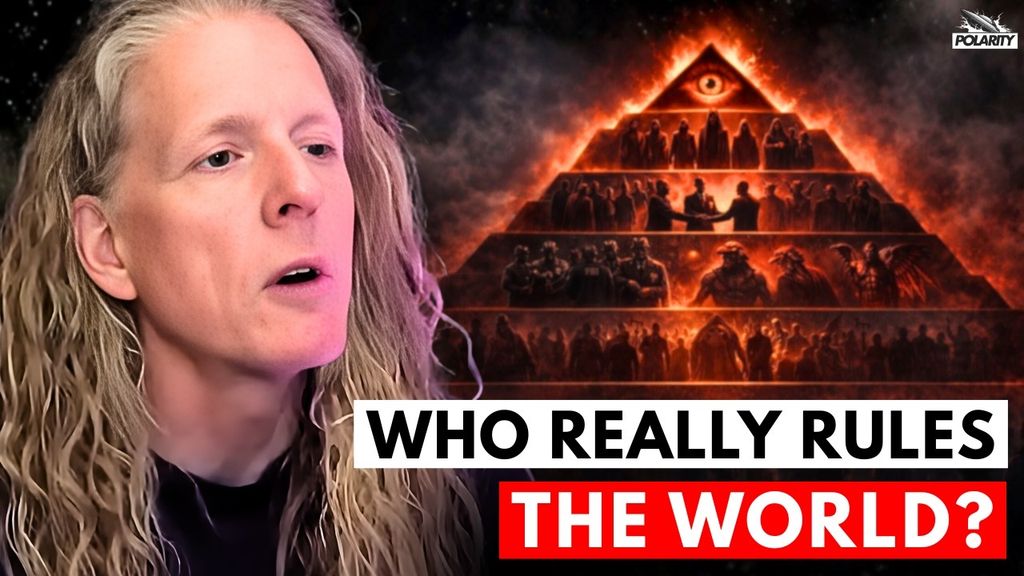
Long-Form Presentation Revives 'Khazarian Mafia' Claims, Linking Ancient Cult Allegations to Modern Power and UAP Secrecy Debates


A persistent current in alternative history and disclosure communities holds that modern institutions are the culmination of an occult power structure with ancient roots. In a recent long-form presentation, Polarity’s host Josh curated and commented on an extensive narrative by Chuck Swindoll Jr. that asserts a multi-millennial arc of influence by a purported 'Khazarian Mafia' aligned with the Cult of Ba’al. The argument reaches beyond conventional political critique, alleging a hierarchy that begins with metaphysical evil (Ba’al/Moloch/Satan), descends through 'watchers' and Nephilim bloodlines, and ultimately manifests in human organizations—religious orders, fraternal societies, intelligence services, and financial elites. Within this framework, the program connects contested historical interpretations and spiritual texts with contemporary debates over UAP transparency, trafficking, and the integrity of science and medicine.
At the core of the presentation is a cosmology of control. It posits that human consciousness and history have been constrained by a parasitic force that profits from division, secrecy, and degraded self-knowledge. The host echoes a common refrain in disclosure circles: that meaningful progress requires a period of 'unlearning'—shedding trusted narratives about government, science, and faith that, in this view, have been instrumentalized to limit inquiry. The Book of Enoch, often referenced on the fringes of UAP discourse, is presented as a historical lens for 'watchers' who interfere with humanity. This thematic move attempts to place modern secrecy claims in a mythic continuum—suggesting that apparent twenty-first century anomalies, from unidentified craft to alleged deep-underground activities, are the latest expression of a longstanding pattern.
The program’s historical scaffold invokes the Younger Dryas, a period around 12,800 years ago marked by abrupt climatic change. The presentation aligns with proponents of an impact hypothesis who argue that a large extraterrestrial object struck the Greenland ice sheet, unleashing floods and burying evidence of prior civilizations. Within the narrative, this event becomes more than climate shock; it is framed as a strategic 'attack' that erased records and reset human development. This hypothesis is controversial in academic circles, where debate continues about the extent, causes, and civilizational consequences of Younger Dryas changes. While the climate episode is widely acknowledged, claims that it was a deliberate strike are speculative and rest outside mainstream scholarship.
Building on this speculative prehistory, the analysis situates the Khazar Khaganate—an actual medieval polity north of the Caucasus—within a much broader and more contentious storyline. The program alleges that Khazarian groups along trans-Eurasian trade routes used deception, poisoning, and impersonation to accumulate wealth and identities, developing an enduring template for infiltration. It suggests that this 'costume' strategy—appearing as benefactors, clerics, physicians, or public servants while allegedly pursuing predatory aims—evolved into a system of governance that masks exploitation behind respectable façades. These claims are not supported by primary historical sources and are heavily disputed by historians. Moreover, experts warn that modern 'Khazarian Mafia' narratives often recycle longstanding antisemitic tropes by conflating complex medieval histories with present-day communities; responsible reporting requires clear separation of historical fact from ideological constructs.
The presentation also advances a suite of biological assertions intended to anchor the 'manipulation' thesis in genetics. Chief among them is the claim that human chromosome 2 bears the unmistakable mark of laboratory-style fusion, allegedly proving ancient genetic engineering. In established genomics, the fusion of chromosome 2 is explained as a natural head-to-head telomere fusion event in a hominin ancestor; its signatures—such as the presence of vestigial centromeric and telomeric sequences—are considered evidence of evolutionary processes rather than artificial intervention. The program additionally repeats common but inaccurate talking points that humans use only 5–8% of their brains and that 95% of DNA is 'junk.' Neuroscience demonstrates that virtually all brain regions have functions, and the 'junk DNA' label has been superseded by recognition that non-coding regions play regulatory and structural roles even if not all functions are known. These scientific counterpoints do not settle philosophical questions about consciousness or origins, but they underscore the gulf between the narrative’s biological claims and current peer-reviewed evidence.
Allegations of ritual abuse and cannibalism figure prominently in the program’s attempt to draw a straight line from ancient cult practices to modern power. Survivors’ testimonies and anecdotal accounts are cited to argue that elite initiation requires child harm, and that 'blood as currency' confers vitality and status. The presentation references 'adrenochrome' to explain alleged motives for torture. In chemistry, adrenochrome is a compound formed by oxidation of adrenaline; no credible evidence supports an institutionalized trade in human-derived adrenochrome or its purported psychoactive or anti-aging properties. Law enforcement and social scientists view previous panics around organized satanic abuse with caution, noting how moral panics can fuse real crimes with unsubstantiated, expansive conspiracies. While all allegations of trafficking and abuse warrant serious investigation, the broad, transhistorical claims presented here remain unverified.
A substantial strand of the program critiques medicine and philanthropy. John D. Rockefeller is depicted as the architect of an overhaul that sidelined herbal medicine and embedded petrochemical pharmaceuticals as the medical 'gold standard.' Historically, early twentieth-century reforms such as the Flexner Report consolidated allopathic medical education, improving standards but also narrowing professional pathways and suppressing some traditional practices. Contemporary concerns about pharmaceutical influence are well documented—lobbying, pricing, and marketing practices contribute to public mistrust and policy debates. However, the presentation’s portrayal of a single orchestrating hand and a unified, occult agenda guiding medicine from the early 1900s to the present extends far beyond the historical record.
The narrative repeatedly returns to UAP secrecy as an interpretive key. The host contends that recent testimony, alleged whistleblower statements, and shifting official postures hint at a reality so disquieting that even past presidents are said to have been shaken by briefings. The program references figures in the UAP milieu and suggests that aspects of disaster response, black-budget programs, and deep-underground facilities may conceal darker activities. This interpretation reflects a segment of the UAP community that integrates religious and mythic language—'watchers,' 'Elohim'—with governance critiques. It stands alongside more prosaic explanations that focus on sensor artifacts, adversary platforms, or compartmented technology programs. As with other elements of the presentation, concrete, verifiable evidence is sparse, and source evaluation is critical.
Beyond specific claims, the program dwells on information ecosystems and cognition. It warns against 'echo chambers,' urges individuation from herd consensus, and frames awakening as a painful but necessary step toward autonomy. These themes resonate across ideological spectra: many observers acknowledge that polarization, media silos, and institutional mistrust complicate collective problem-solving. At the same time, the rhetorical posture—casting mainstream education, science, medicine, and religion as monolithically corrupt—can amplify alienation and inadvertently make audiences more susceptible to totalizing explanations. Balanced scrutiny involves distinguishing legitimate systemic critiques (e.g., conflicts of interest, secrecy in national security) from sweeping theories that conflate disparate phenomena into a single hidden architecture.
The implications of the program’s claims are far-reaching. If they were substantiated, they would call for extraordinary legal, scientific, and ethical reckonings. In the absence of such proof, the immediate public-policy takeaways are more grounded: improve transparency where possible, especially around UAP data; strengthen independent oversight of classified programs; ensure vigorous, victim-centered investigations of trafficking allegations; and expand scientific literacy so extraordinary claims can be weighed against verifiable data. In parallel, expanding access to primary historical sources and peer-reviewed research can help audiences disentangle contested medieval histories, apocryphal texts, and modern identity politics from the recurring 'Khazarian' motif.
This presentation exemplifies an emergent genre that fuses spiritual critique, alternative archaeology, bio-speculation, and institutional skepticism under a single explanatory umbrella. Its power lies not only in its dramatic claims but in its promise of coherence across bewildering domains—war and finance, religion and medicine, science and secrecy. For readers and policymakers alike, the challenge is to uphold empathy for those seeking answers while maintaining rigorous standards of evidence. UAP debates will continue to test the balance between transparency and national security; historical research will continue to revise our understanding of ancient cultures; and medicine will continue grappling with corporate influence and public trust. In each area, meaningful progress depends less on cosmologies of hidden control and more on verifiable facts, accountable institutions, and the steady work of separating what can be shown from what is only asserted.
Key Moments
- 00:37The host frames the discussion as an effort to understand "crazy times," suggesting clarity can mitigate public anxiety.
- 01:29The presentation asserts that "demonic" and "cannibalistic" forces have ascended to positions of power, and that examining their origins explains current events.
- 05:38Disclosure is cast as an 'unlearning' process; the host cites statements attributed to Col. Karl Nell about longstanding non-human intelligence engagement with humanity.
- 09:23Chuck Swindoll Jr. outlines a timeline from humanity’s purported origins to roughly 100 AD as a prelude to the alleged formation and westward infiltration of the Khazarian Mafia.
- 18:13A hierarchical schema is presented: Satan/Ba’al/Moloch at the top, followed by fallen angels/watchers/archons, Nephilim-linked 'black nobility,' and then human institutions such as Jesuits, Freemasons, and elite committees.
- 19:01The Book of Enoch is invoked to support claims that 'watchers' interfered with human affairs and genetics, producing hybrid lineages.
- 24:24Human society is characterized as a 'farm' manipulated by a parasitic evil; the proposed remedy is personal and collective knowledge.
- 28:27Mainstream medicine, politics, religion, and education are described as 'poisons' that narrow perception and maintain control.
- 29:03Cliff High’s 'Walk Without Rhythm' Substack post is introduced as a framework tying human origins, catastrophic events, and societal manipulation.
- 33:50The narrative claims human chromosome 2 reflects artificial 'fusion' inconsistent with evolution, suggesting laboratory-style genetic alteration.
- 44:48An 'Elohim' demonic species is alleged to have engineered humans by shortening lifespans and reducing cognitive capacity while preserving spiritual sensitivity.
- 57:46Slides depicting telomere-to-telomere fusion are cited as evidence of engineered DNA; the analogy likens it to a visible 'dent' left by an inferior designer.
- 01:17:12The Younger Dryas event is portrayed as a targeted cataclysm that reshaped Earth and disrupted prior civilizations, muddying historical records.
- 01:44:59A Silk Road-era scenario is described in which Khazarian groups purportedly drugged, murdered, and impersonated traders to capture wealth and identities.
- 01:54:45John D. Rockefeller and 'Big Pharma' are accused of marginalizing herbal medicine and reshaping medical curricula to favor petrochemical drugs and centralized control.
Related Topics
Links & References
- Chuck Swindoll Jr. presentation cited throughout the program.
- Polarity playlist featuring UAP-related deep dives referenced by the host.
- Channel memberships link shared for support.
- Direct support link promoted by the host.
- Community Discord invite mentioned for ongoing discussion.
- Merchandise storefront referenced during the program.
 Continue with Google