
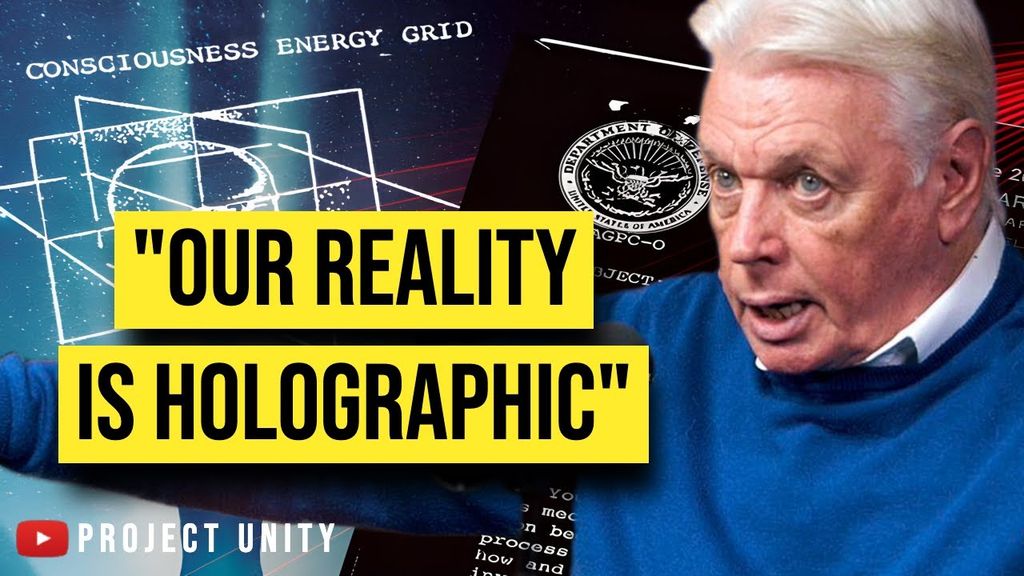
David Icke Cites Declassified ‘Gateway’ Files to Advance Claims of Holographic Reality and Non‑Human Influence


Debate over the limits of consciousness research often intersects with national security programs and evolving theories about the nature of reality. In this discussion, David Icke links declassified materials associated with the Monroe Institute’s Gateway program to far-reaching claims about a holographic universe, reincarnation, and non-human influence on human affairs. He argues that the Gateway analysis—produced within a U.S. military context and later made public—supports an ontology in which consciousness operates beyond physical constraints.
Icke interprets accounts of altered states and out-of-body experiences as evidence for an astral dimension populated by non-human intelligences. He describes recurring encounters with reptilian forms, reportedly nicknamed “the alligators,” and situates them within a wider archonic structure. The framework suggests a strategic effort to steer humanity toward AI–human integration while maintaining social control through fear, conflict, and ideological rigidity.
A core element of the narrative is the idea that fear generates low-vibrational “loosh” energy, a concept originating in Robert Monroe’s writings. Armed conflict and persistent crises are presented as mechanisms that amplify this energy and keep populations in heightened anxiety, with contemporary examples cited to illustrate the dynamic. Parallel to this, secret societies are alleged to act as terrestrial instruments of a hidden architecture of control.
Independent assessments note that the declassified Gateway document is a speculative analysis rather than empirical confirmation of reincarnation or a holographic cosmos. Mainstream science has not validated claims of astral entities or energy harvesting, and evidence standards remain a central point of contention. For researchers at the intersection of UAP studies and consciousness, the discussion highlights an unresolved question: whether non-local aspects of mind and anomalous perception warrant systematic, falsifiable investigation alongside more conventional data and sensor-driven inquiry.
Key Moments
- 00:11Reference to the U.S. military’s involvement with the Monroe Institute’s Gateway program focused on altered states and astral travel.
- 00:33Claim that a once-classified Gateway study was declassified by the CIA and has circulated widely.
- 00:46Assertion that the military overseer’s report concluded reincarnation is real and reality is holographic.
- 01:10Report that participants encountered reptilian entities in the astral dimension, colloquially labeled “the alligators.”
- 01:49Description of a broader non-human presence characterized as an archonic “astral army,” not limited to reptilian forms.
- 02:13Claim that an astral dimension drives a human agenda toward greater control, culminating in AI–human fusion.
- 02:36Argument that fear is cultivated to generate low-vibrational “loosh” energy allegedly consumed by non-human forces.
- 03:19Use of The Matrix battery analogy to describe humanity as an energy source within a computed reality.
- 03:56Citations of wars, including Gaza after October 7, as examples of events producing mass anxiety and “loosh.”
- 04:32Claim that a small, informed group steers AI–human integration to manage and control large populations.
- 05:02Contend that rigid belief systems and ideologies act as perceptual boxes that facilitate control.
- 05:59Naming of secret societies—Knights of Malta, Knights Templar, inner core of the Jesuit order, Opus Dei, Skull and Bones—as alleged organizing nodes.
- 06:46Conclusion that human society is manipulated by unseen forces.
- 06:58Personal note on a long, iterative research journey built on documents, people, and experiences.
 Continue with Google