
Project Unity Documents Locked Subterranean Entrances and False Doors on the Giza Plateau


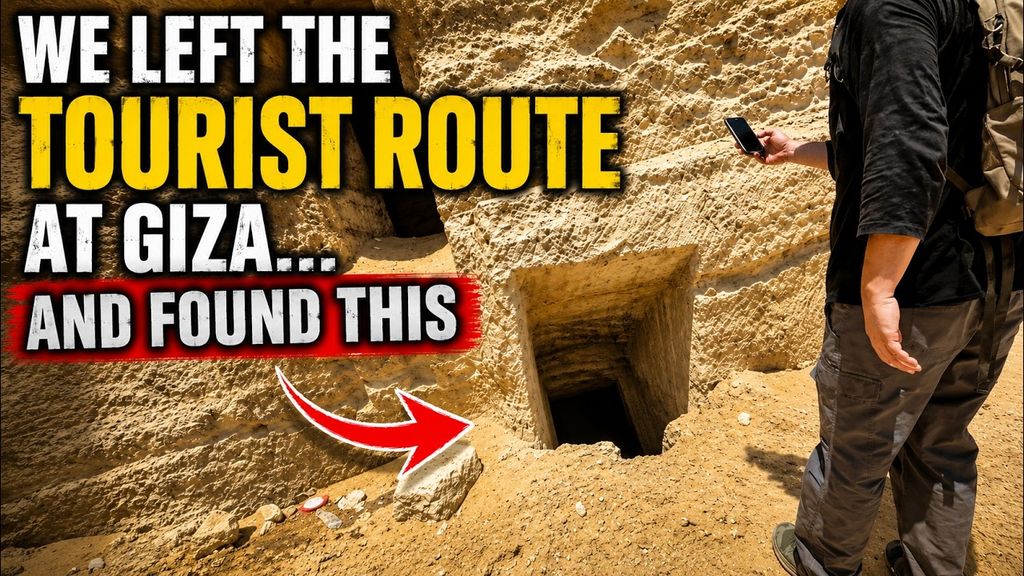
Project Unity documents a seldom-seen side of the Giza Plateau by moving away from the main tourist route and focusing on locked subterranean entrances, blocked shafts and carved false doors. Host Jay emphasizes that these features are scattered across the plateau yet remain largely inaccessible, with gates, infill and masonry walls preventing visitors from exploring what lies beneath. The exploration highlights a pattern of subterranean architecture that appears far more extensive than the exposed surface monuments suggest.
Early in the walk, the team inspects a steep shaft that looks like an air shaft or access shaft but is too dangerous to descend. Nearby, they encounter a series of gated entrances cut into the bedrock. Some are plain, others carry inscriptions and more refined stonework. Jay notes that the traditional Egyptological interpretation frames these as worker burial chambers associated with the pyramid construction crews. He questions this explanation, arguing that the considerable variation in the style and finish of the entrances, along with their distribution, does not resemble standard dynastic tomb architecture.
Several entrances feature visible subterranean passages beyond locked iron gates, indicating that these are not shallow alcoves but potential access points to deeper networks under the plateau. In other locations, vertical shafts and openings have been filled in at the surface, with Jay pointing out that the infill likely conceals substantial depth. One particularly precise stone entrance is singled out as looking very important, yet it too is locked and positioned away from dense tourist traffic. For Project Unity, this repeated pattern of secured or filled access points supports the impression that systematic restriction of subterranean areas has been implemented.
The survey also focuses on architectural details such as false doors carved into rock faces in compact, tucked-away spaces. Jay draws a comparison between these false doors and similar motifs found in Peru and throughout Egypt, and wonders whether such locations could mark hidden or buried subterranean entrances now sealed beneath later construction or debris. Around some of these structures, companions describe the plateau as feeling like the “wild west,” underscoring how informal and unregulated the margins of the site can appear despite the clear presence of deliberate barriers.
Dogs sheltering in the cool of the shaded entrances and shafts add a practical obstacle to any attempt to descend, but they also highlight how these spaces provide real depth and environmental contrast beneath the desert surface. Repeatedly, the team encounters walled-off corridors, gated stairways and plugged passages that show clear evidence of once providing access underground. Project Unity frames this as an underappreciated dimension of Giza: beyond the iconic pyramids and official tombs, a hidden network of subterranean entrances, false doors and blocked shafts points to a far more complex substructure that, for now, remains largely off-limits to independent investigation and to researchers interested in deeper questions around human history and potential non-standard interpretations often associated with UAP and ancient advanced civilization debates.
Key Moments
- 00:05The group examines a steep, narrow shaft that appears to function as an air shaft or access shaft, but decide it is too dangerous to climb down.
- 00:50Multiple gated entranceways are observed along the plateau, some of which are simple openings while others are more elaborate, all secured and inaccessible.
- 01:26Jay notes the mainstream Egyptological view that these doors and shafts are burial chambers for pyramid builders, but argues this is unlikely given the wide stylistic variation and presentation.
- 01:54He states that the entrances do not appear to be typical dynastic tomb entrances, pointing to differences in style and inscriptions.
- 02:15One locked entrance reveals a further subterranean passage visible beyond the gate, suggesting a deeper network below the surface.
- 03:11Semi-feral 'temple dogs' occupy some of the shaded subterranean spaces, further discouraging attempts to climb down into the shafts.
- 04:09Several vertical access points and shafts across the plateau are noted as having been filled in, indicating they once descended much deeper than is currently visible.
- 04:22An especially precise and carefully finished stone entrance is highlighted as looking 'very important,' yet it is locked and off-limits.
- 05:37Jay characterizes the area off the main tourist route as where ‘evidence of some suspicious activity’ can be found, focusing on stonework and sealed features that receive little public attention.
- 06:04Carved false doors similar to examples in Peru and elsewhere in Egypt are shown in a small, tucked-away area, prompting questions about their original purpose.
- 06:26He speculates that the false-door zone may conceal a buried subterranean entrance point, suggesting the possibility of hidden access beneath the surface.
- 06:46A potential entrance is found that appears to lead inside a structure but is fully walled off, another example of blocked access to older parts of the site.
- 08:06A clearly engineered subterranean entrance is discovered behind a gate, confirming that at least some of the sealed openings once allowed passage underground.
- 08:43A final blocked subterranean entrance is shown, where a passage appears to have been deliberately plugged with rocks, mud and debris, implying it once extended much further than is now visible.
Related Topics
Links & References
- Full episode of Project Unity's exploration of locked and subterranean features on the Giza Plateau.
- Project Unity Patreon page offering early access to content and a private Discord server.
- Buy Me a Coffee page for supporting Project Unity.
- PayPal donation link to support Project Unity.
- Project Unity account on X (Twitter) for updates and commentary.
- Contact email for Jay at Project Unity.
 Continue with Google