
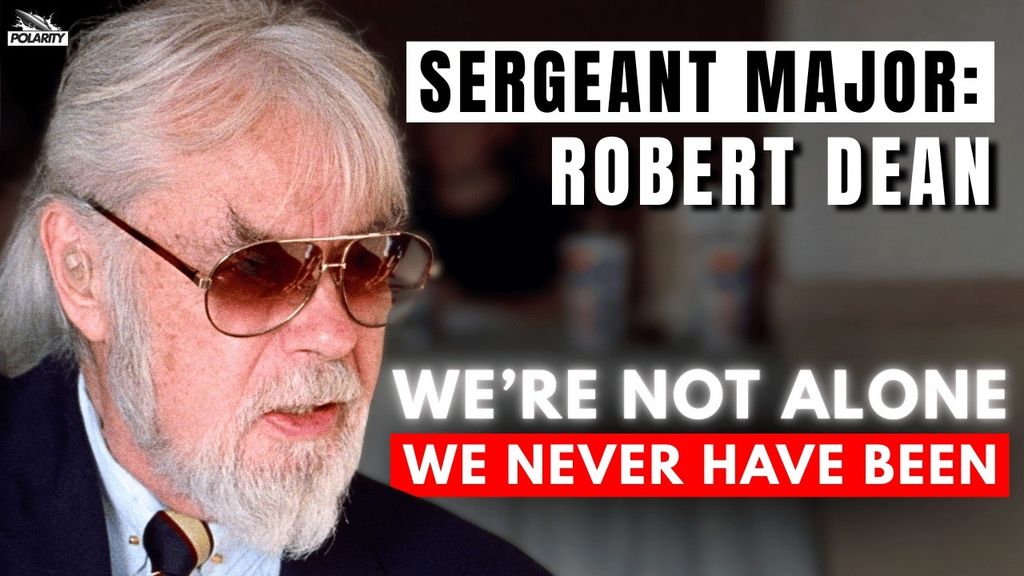
Revisiting Robert Dean’s Claims: Human Hybrids, Covert Space Programs, and the Struggle Over UAP Disclosure


The debate over how to disclose information about Unidentified Anomalous Phenomena has always hinged on two linked questions: what is actually known and how society would cope if the most disruptive claims proved true. A 2011 lecture by retired U.S. Army Command Sergeant Major Robert O. Dean—revisited and analyzed in detail—asserts answers that, if validated, would fundamentally reorder political accountability, scientific orthodoxy, and human self-understanding. Dean’s claims are expansive: that humanity is a genetically engineered hybrid species, that non-human intelligences have long been interwoven with human history, that covert aerospace capabilities already surpass public science by orders of magnitude, and that disclosure is occurring by acclimatization rather than formal announcement. These assertions are contested and, in many cases, unverified. Yet they encapsulate a body of testimony and lore that continues to shape public expectations for UAP transparency and to motivate calls for document releases and empirical tests.
Dean’s military biography gives his testimony a durable platform in UAP circles. He served as a Command Sergeant Major, worked at NATO’s Supreme Headquarters Allied Powers Europe (SHAPE), and held a NATO “Cosmic Top Secret” clearance. He said his perspective changed after reading a classified “assessment” in the 1960s that synthesized postwar reporting on anomalous craft and intelligences. On the strength of this background and subsequent engagements, he concluded that humans are the product of a directed genetic program by advanced non-human actors and that this manipulation continues. He preferred the term “the others” over “alien,” arguing the latter distorts the relationship by implying novelty or distance. In his telling, they are not visitors; they have been here longer than we have and, in some instances, are physically indistinguishable from us.
Such claims fall into a broader UAP discourse where technology, biology, and cosmology intersect. Dean placed special emphasis on interdimensionality, saying that by the mid-1970s he learned of officials grappling with craft and entities transiting via “portals.” He extended this into a geography of alleged installations—including Mount Hayes in Alaska, El Yunque in Puerto Rico, a Pyrenean site, and underground activity near Pine Gap in Australia—portrayed as nodes in a terrestrial presence. The narrative situates UAP not as intermittent intrusions, but as an enduring ecosystem in which human societies exist alongside, and perhaps within, a larger operational footprint.
A second pillar of Dean’s account concerns disclosure. He dismissed the notion of a single presidential press conference announcing extraterrestrial contact, arguing the issue is too vast and disruptive to compress into an event. Instead, he described a “subliminal education” strategy that acclimates the public through culture—films, television, books, and conferences. He cited Steven Spielberg’s body of work as archetypal: family-friendly empathy in E.T., institutional friction in Close Encounters of the Third Kind, and a more adult tapestry in the Taken miniseries. An anecdote often repeated in UAP communities—President Reagan supposedly remarking that only a handful in a screening room grasped how true Close Encounters was—appeared here as a parable of selective awareness. Whether or not every cited exchange occurred as recounted, the broader thesis is that culture has become both carrier and cover for ideas that once were taboo.
Dean’s skepticism about event-style disclosure draws on a staple reference in UAP literature: the 1960–61 Brookings Report, “Proposed Studies on the Implications of Peaceful Space Activities for Human Affairs.” He interpreted its cautionary language as a policy rationale for secrecy, adding an anecdote about a Papua New Guinea youth exposed abruptly to modernity whose worldview collapse led to tragedy. The analogy, he suggested, maps onto mass ontological shock that could follow full-spectrum disclosure—upending religion, science, and social cohesion. While this interpretation of Brookings is debated by historians, the societal-impact question remains central for contemporary policymakers weighing how to handle unprecedented data.
The technological thread in Dean’s lecture points to a covert aerospace enterprise far beyond the public-facing space program. He referenced the work of aerospace figures frequently cited in disclosure narratives. NASA and McDonnell Douglas engineer David Froning purportedly spoke in 1993 about decades of “hyperluminal” flight achieved by exotic field propulsion and spacetime manipulation. Former Skunk Works chief Ben Rich has been attributed with two provocative claims: that classified capabilities are roughly a century ahead of mainstream science and that “we can now take ET home.” The authenticity and interpretation of such quotes are disputed; nonetheless, they are keystones in arguments that public spaceflight is a curated façade for deeper classified progress.
Dean then linked technological claims to governance and finance. He noted a 1987 statement by Senator Daniel Inouye referencing a “shadowy government” with independent military and fundraising mechanisms, and he cited late-1990s General Accounting Office notices of vast unaccounted federal sums. He used these to frame assertions of a multinational “Aerospace Command” beyond normal oversight, complete with orbital platforms and off-world deployments. He tied this further to UK hacker Gary McKinnon’s early-2000s claims of discovering references to “non-terrestrial officers” and fleet-to-fleet transfers in U.S. military systems—allegations that have never been adjudicated in open court with full evidence but which intensified public suspicions of a parallel space posture.
From propulsion and policy, Dean moved to imagery and deep-space anomalies. He alleged that NASA “inadvertently” erased lunar film while Japan’s space agency retained copies via prior contractual purchases, and he described Apollo-era photographs showing large objects transiting near the Moon, including a purported five-mile-long craft. He further cited engineer Norman Bergrun’s book, The Ringmakers of Saturn, which presented Voyager-era imagery interpreted as immense electromagnetic vehicles operating within Saturn’s rings, some allegedly thousands of miles across. Critics argue such features can be image processing artifacts, ring dynamics, or misinterpretations; Bergrun’s work is not accepted in mainstream planetary science. Still, these examples illustrate how gaps in public data, archival anomalies, and ambiguous images continue to feed alternative readings about non-terrestrial activity.
Woven throughout Dean’s presentation was a taxonomy of roles attributed historically to “the others”—watchers, builders, gardeners—and a list of scientific disciplines implied to be engaged in a long-term study of, and interaction with, humanity. He portrayed their interest as familial rather than imperial, downplaying invasion narratives and describing a mentorship that aligns with his hybridization thesis. He also leaned on quotations attributed to thinkers spanning a century—Charles Fort’s “we are property,” Wernher von Braun’s caution about unknown powers, Hermann Oberth’s suggestion of external help in scientific advances, and a controversial quote ascribed to astrophysicist Fred Hoyle about alien control. Several of these quotes are contested or lack clear primary sourcing, a reminder that much of the UAP canon depends on oral transmission and secondary citations that demand rigorous verification.
The discussion underscored an enduring fault line: testimony versus testable evidence. Dean’s narrative aggregates military recollections, cultural signals, contested quotations, and interpretive readings of imagery into a single explanatory arc. For proponents, the cross-domain coherence is itself evidentiary. For skeptics and method-driven researchers, the absence of verifiable documentation, chain-of-custody for imagery, or replicable measurements is disqualifying. That divide has practical consequences. If high-energy field propulsion, vacuum energy extraction, or interdimensional transit artifacts are real and sequestered, then decades of energy and aerospace research have proceeded with an artificially constrained knowledge base. If not, then the focus should remain on improving sensor fidelity, data transparency, and hypothesis testing within known physics.
Policy and public communication sit at the center of these tensions. Even without accepting Dean’s strongest claims, the question of how to handle disruptive information remains. The last decade has seen a cautious normalization of UAP reporting channels and limited data releases, alongside continuing classification and sensor redactions. Advocates for broader transparency argue that incremental releases risk eroding trust; officials counter that premature, decontextualized disclosures can mislead or trigger the very destabilization Brookings warned about. The path forward likely lies in clear evidentiary thresholds, robust independent review, and structured, multinational scientific programs insulated from political cycles and parochial secrecy.
There are tangible steps that could adjudicate elements of Dean’s narrative without presupposing outcomes. First, a consolidated, independently curated archive of historical space imagery—with complete provenance, scanning notes, and processing metadata—could help resolve recurring claims about lunar and planetary anomalies. Second, lawmakers could require classified program offices to provide in-camera briefings and inspector general audits specifically addressing alleged unacknowledged aerospace systems and their funding streams, with public summaries released when feasible. Third, declassification reviews could prioritize documents known by title in the public domain—such as the NATO “assessment” Dean referenced—so that authentic records, even if partially redacted, can be weighed against anecdote. Fourth, scientific bodies could open-call studies on high-caliber UAP datasets, balancing sensor artifacts against performance claims and publishing methods as much as conclusions.
Finally, the societal dimension cannot be disentangled from the technical. If the subject intersects with beliefs about human origins, consciousness, or metaphysical frameworks, policymakers and communicators should plan for responsible framing that neither inflates fear nor dismisses legitimate curiosity. Dean’s account—whether viewed as warning, witness, or window into a subculture—highlights the stakes: the integrity of science and governance; the credibility of institutions; and the resilience of a public asked to integrate extraordinary claims. The central question is not only whether any specific assertion is true, but whether mechanisms exist to test them transparently. Without those mechanisms, disclosure becomes an ambient drift rather than a deliberative process, and the public remains caught between speculation and secrecy.
In that sense, the most consequential legacy of accounts like Dean’s may be procedural. Either the claims catalyze a verifiable body of data that withstands scrutiny, or they accelerate reforms that make such scrutiny possible. Both outcomes move the UAP conversation from folklore to falsifiability—an essential step if society is to reconcile curiosity with credibility.
Key Moments
- 02:27Background on Robert O. Dean: retired U.S. Army Command Sergeant Major, former NATO staff at SHAPE with 'Cosmic Top Secret' clearance, who said he read a classified assessment on non-human intelligences in the 1960s.
- 12:34Core claim: the human race is a long-running genetic hybrid project, engineered by advanced non-human intelligences and still under active modification.
- 15:43Dean rejected the terms 'alien' and 'UFO,' asserting many craft are known, with some originating from human programs, some from 'others,' and some allegedly from Nazi-era developments.
- 23:34On disclosure: Dean argued an official, single-event disclosure is unlikely because the story is 'too big,' spanning multiple dimensions of contact and civilization-scale implications.
- 25:49Presence and infrastructure: Dean claimed non-human groups are longstanding, not 'visitors,' citing alleged facilities under Mount Hayes (Alaska), El Yunque (Puerto Rico), the Pyrenees, and near Pine Gap (Australia).
- 28:39Among us: He said some non-human intelligences are indistinguishable from humans and occasionally attend public events to observe how audiences respond to UAP-related information.
- 40:48Societal impact: Using the Brookings Report (1960–61) and an anecdote about 'Billy Doo' in Papua New Guinea, Dean argued that abrupt disclosure could trigger destabilizing ontological shock.
- 57:15Gradual disclosure: He described a 'subliminal education' strategy through films, TV, and literature; cited Steven Spielberg’s works and an anecdote attributed to President Reagan about Close Encounters.
- 01:17:11Advanced propulsion claims: Dean referenced NASA/McDonnell Douglas engineer David Froning’s 1993 statement about decades of 'hyperluminal' flight via exotic field propulsion.
- 01:17:29Ben Rich claim: He quoted the former Skunk Works chief as saying classified aerospace is a century beyond mainstream science and 'we can now take ET home.'
- 01:21:09Governance and funding: Dean cited Sen. Daniel Inouye’s 1987 remarks about a 'shadowy government' and referenced late-1990s GAO notices of unaccounted federal sums to suggest hidden programs.
- 01:29:11Secret space posture: He alleged a multinational 'Aerospace Command' with orbital platforms and craft exists, linking it to hacker Gary McKinnon’s reported findings of 'non-terrestrial officers.'
- 01:39:08Imaging controversies: Dean said NASA 'erased' lunar film while JAXA retained copies; he described Apollo-era photos of large objects and lunar installations, including an alleged five-mile-long craft.
- 01:49:43Deep-space anomalies: He cited Norman Bergrun’s 'Ringmakers of Saturn,' claiming electromagnetic vehicles—some thousands of miles long—operate in Saturn’s rings.
- 01:57:49Scientific resistance: Dean recounted Stanton Friedman’s exchange with SETI’s Seth Shostak to illustrate institutional reluctance to assess UAP evidence, concluding many elites are unprepared for paradigm shifts.
Related Topics
Links & References
- Curated playlist of UAP-related deep dives referenced as additional context.
- Community discussion hub where post-show viewing and debate were organized.
- Channel membership link cited during the program.
- Support link mentioned for audience contributions.
- Merchandise store mentioned; included for completeness of referenced resources.
 Continue with Google