
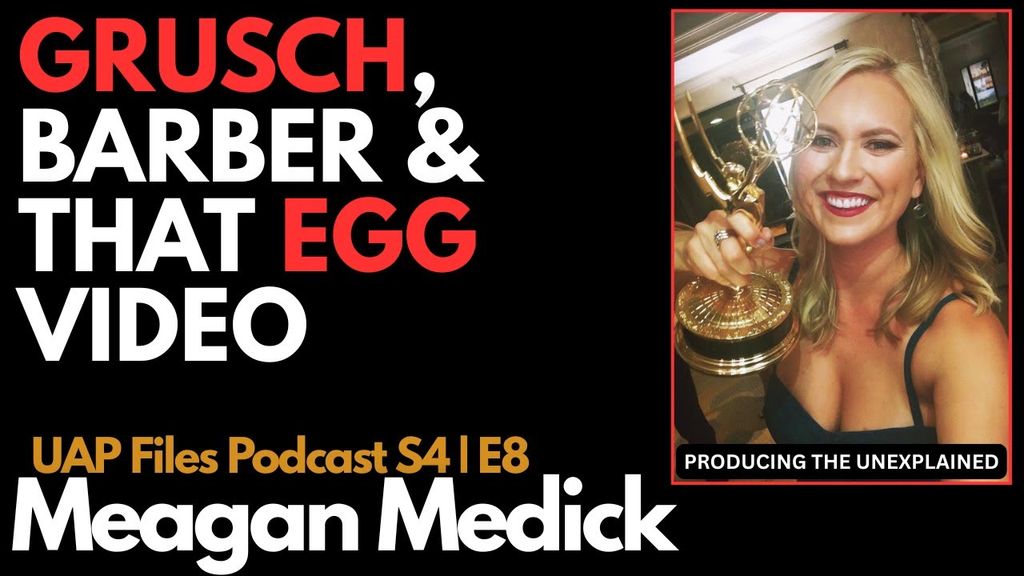
Inside NewsNation’s UAP Coverage: Producer Outlines Vetting Standards, Source Protection, and the ‘Egg’ Video


Major newsrooms continue to grapple with how to cover Unidentified Anomalous Phenomena in a way that is both rigorous and appropriately contextualized. NewsNation’s approach, described by producer Meagan Medick, offers a case study in the editorial, operational, and ethical calculations that underpin high-profile UAP reporting—spanning whistleblower testimony, field coverage, and the handling of sensitive source material.
Medick’s account situates NewsNation’s UAP focus in a concrete editorial decision: Ross Coulthart brought the David Grusch whistleblower story to the network. That choice signaled a willingness to engage a topic often relegated to brief, surface-level treatment elsewhere. The fallout was immediate and measurable, feeding congressional interest while expanding audience recognition for the outlet’s investigative posture. In Medick’s view, this trajectory validated the investment and highlighted a broader point—UAP narratives are too complex for compressed TV formats. She argues that long-form podcasts and extended interviews can preserve nuance, prevent misinterpretation, and give viewers the time needed to assess evidence and credibility.
The practical mechanics behind the coverage involve a structured intake and verification process. Medick describes a steady influx of emails, videos, and lengthy testimonies sent to multiple inboxes. Preliminary screening is followed by requests for corroborating details, checks against flight paths or other environmental data, and, in some cases, on-the-ground follow-up. One Los Angeles case—initially compelling—was ultimately determined to be planned; rather than air it, the team declined to proceed. That decision, Medick stresses, reflects a core editorial principle: avoid amplifying weak or misleading claims in a subject area where public trust is already fragile. The goal is to protect the integrity of the discourse and the broader community of researchers and experiencers.
The network’s handling of prominent figures underscores these standards. Medick points to the Grusch interview as an example of anticipatory journalism. By addressing foreseeable lines of criticism—such as questions about mental health—on the record, the production attempted to provide audiences with clarity that would endure beyond any subsequent leaks or selective narratives. The same disciplined approach, she says, shaped a separate special centered on Jake Barber. Security protocols limited the internal spread of sensitive details; Medick learned Barber’s identity only shortly before broadcast. Obtaining a piece of evidence—the so-called ‘egg’ video—required additional operational safeguards, including the use of a burner phone and a discreet, cold-weather retrieval of a flash drive. The steps, as recounted by Medick, reflect both source concerns and the outlet’s commitment to protecting individuals who come forward.
The evidence itself remains a focal point for public curiosity. Medick describes repeatedly reviewing the ‘egg’ video and characterizing the object as anomalous. She frames the larger transparency question in civic terms: members of the public are capable of critical evaluation and should be allowed to review material that raises legitimate questions about what is being observed in controlled or military contexts. This perspective extends to the secrecy debate. While acknowledging national security considerations, Medick questions the legitimacy of withholding information that could touch on foundational scientific or existential issues, including humanity’s place in the universe. She notes that her religious faith leads her to keep multiple explanatory frameworks in play, from spiritual interpretations to simulation theory, and she resists premature closure on any single theory.
Medick’s assessment of disclosure places more weight on cultural conditioning than on formal government initiatives. She sees Hollywood—via films and television—as functioning as a soft form of disclosure by normalizing ideas that might otherwise be destabilizing if introduced abruptly. In contrast, she regards bureaucratic red tape and legal constraints as impediments to official transparency, and warns that individuals who attempt unilateral disclosure could face serious personal risk.
Looking ahead, Medick points to ‘Ross Coulthart Investigates’ on YouTube as a venue for future releases. She says some sources are wary of traditional platforms and prefer direct publication channels they perceive as more controllable or less institutionally encumbered. For independent creators, her advice is pragmatic: persist through low-visibility periods, pursue genuinely new angles, and seek updates or exclusive materials that meaningfully advance public understanding. Within a field marked by high public interest and uneven data quality, she argues that consistent methodology, patience, and a focus on verifiable additions are the best ways to move the conversation forward.
Key Moments
- 02:21Medick says her entry into UAP reporting stemmed from working with Ross Coulthart and being immersed in deep-dive casework rather than a single triggering incident.
- 03:20She outlines her broadcast background—USC-trained, executive producer roles in Las Vegas and San Diego, and becoming one of NewsNation’s two original executive producers when the network launched.
- 05:20Medick recounts on-the-ground reporting at the National Press Club in Washington, D.C., describing live coordination, audience engagement, and field-production pressures.
- 09:26According to Medick, NewsNation’s decision to pursue UAP coverage accelerated after Coulthart brought the David Grusch whistleblower story, which later fed into congressional attention and boosted the network’s visibility.
- 11:12She argues long-form podcasts are better suited to UAP than short TV segments, which often compress complex facts into 90-second packages that can confuse audiences.
- 13:28Medick describes a rigorous intake and vetting pipeline: tips arrive via multiple inboxes with videos and testimonies; the team requests additional details and conducts verification, sometimes deploying a camera crew.
- 14:18An example vetting outcome: a Los Angeles case that initially appeared promising but was determined to be planned, leading the team to drop the story rather than broadcast uncertain material.
- 15:45She emphasizes responsibility to avoid platforming non-credible claims, citing the fragility of the topic and potential harm to the broader research community.
- 16:54On the Grusch interview, Medick praises anticipatory editorial choices that addressed mental-health issues likely to surface later, framing them directly and on the record.
- 17:40Regarding the Jake Barber special, Medick says operational secrecy was extreme—even she learned Barber’s name only a month before air to protect safety and confidentiality.
- 18:30She details how NewsNation obtained the ‘egg’ video: a boss using a burner phone followed remote guidance to retrieve a flash drive hidden in snow, illustrating source-protection measures.
- 19:40Medick describes replaying the ‘egg’ video repeatedly, calling the object anomalous and asserting the public’s right to evaluate such material and ask, “What is that?”
- 20:28She questions secrecy around potential existential or scientific information, arguing that withholding breakthroughs or context about humanity’s place in the universe is unjustified.
- 22:26Medick shares that her religious faith shapes a flexible, evolving interpretation of the phenomenon, entertaining possibilities ranging from spiritual frameworks to simulation theory.
- 24:27On disclosure, she suspects Hollywood functions as a soft form of acclimatization more than government institutions, citing bureaucratic red tape and risk to individual disclosers.
- 27:47Looking ahead, she says ‘Ross Coulthart Investigates’ on YouTube targets major stories from sources who do not trust mainstream platforms, offering an alternative venue for publication.
- 30:07Her advice to creators: persist, find new angles, and prioritize updates or exclusive material that substantively advances a story.
 Continue with Google