
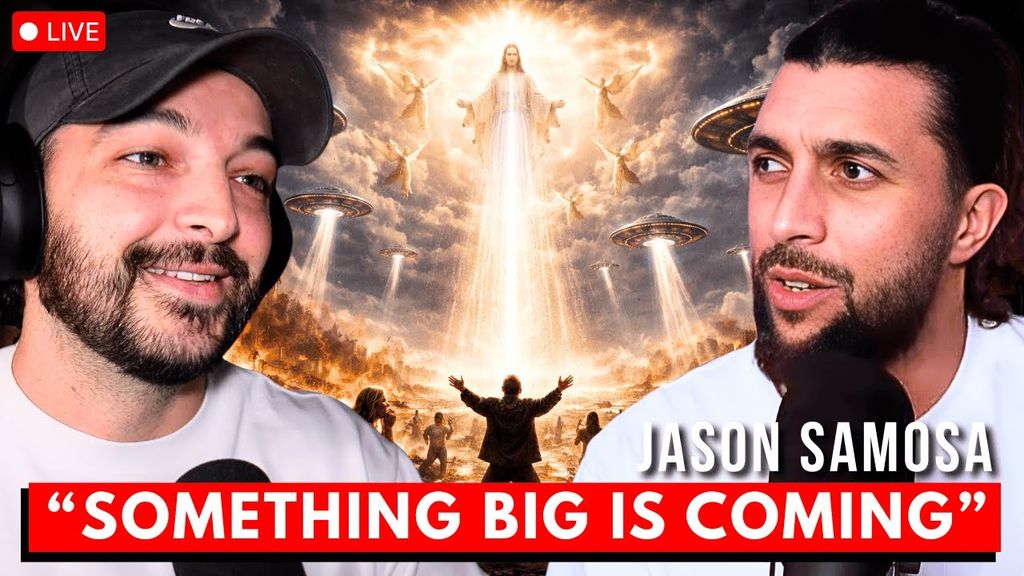
Religion, War, and UAP: Researcher Examines Competing Narratives, Secrecy, and Theological Frames


The intersection of religion, war, and Unidentified Anomalous Phenomena (UAP) increasingly shapes how the public interprets anomalous events and official disclosures. Rather than existing as separate debates, these domains often converge through narratives that mobilize belief, justify secrecy, or channel political will. Researcher and commentator Jason Samosa situates the current moment within a centuries-long contest over who frames reality: secular Enlightenment traditions, religious power centers, intelligence bureaucracies, and cultural industries that translate elite signaling into mass perception.
Samosa’s own point of departure underscores the ambiguity at the core of the topic. He describes a brief sighting near Nevada’s Extraterrestrial Highway of a brown, football-sized sphere moving with apparent intent before vanishing behind clouds. He resists grand conclusions, leaning toward a terrestrial surveillance device. The anecdote serves less as proof than as a reminder: even direct encounters often lack the evidentiary density needed to settle what is at stake. That gap, he argues, has historically been filled by theology, ideology, and controlled narratives.
Theological frameworks continue to influence UAP discourse in subtle and overt ways. Samosa recounts his journey from skepticism to devout Christianity and back to a more eclectic spirituality, emphasizing the ethical force of the Sermon on the Mount while acknowledging longstanding questions about literalist readings of Genesis, the Flood, and the Resurrection. He applies that critical posture to the Collins Elite narrative, contending that its adherents have approached the data with welcome flexibility—considering non-extraterrestrial explanations—yet remain theologically rigid. Instead of treating scripture as a monolith, he urges treating the Bible as a diverse library with variable historical and ethical value by book and genre.
From this vantage point, historic apparitions and religious revivals can be read through Jacques Vallee’s control-system lens. Samosa highlights how reported manifestations appear during civilizational inflection points, a pattern consistent with what behavioral science might call a reinforcement schedule. The mechanism remains unresolved: are these events endogenous to human consciousness, orchestrated by non-human actors, or a mixture of both? The control-system framing allows for partial authenticity, staged interventions, and misclassification across eras without demanding a single reductive explanation.
Information control and the politics of anticipation emerge as central themes. Samosa warns that sustained promises of imminent revelation can immobilize a public that might otherwise demand independent inquiry. His “dinner in an hour” analogy captures the point: when a population expects a meal shortly, it is less likely to forage. The suggestion is not merely cynical; it tracks with institutional behavior. Large bureaucracies rarely make decisive moves absent compulsion. If a disclosure vector exists, Samosa believes it likely responds to pressures beyond public curiosity—geopolitical, technological, cultural, or a confluence thereof. He anticipates competing factions will try to seize the narrative as soon as events crystallize, requiring careful media literacy from audiences.
Religion and war color this calculus, particularly in the Middle East. Samosa evaluates claims that Israeli political strategy includes eschatological goals, such as consolidating territory associated with “Greater Israel” and enabling a future temple. He ties such ambitions to efforts to rally segments of the U.S. public around end-times motifs. Without claiming inside knowledge of any one leader’s beliefs, he notes the inherent tensions this creates for Christians: a claimant to messiahship seated in a rebuilt temple would conflict with Pauline warnings about a “man of lawlessness,” producing competing identifications for the same figure across Jewish and Christian audiences. The result is a narrative field ripe for misunderstanding and manipulation.
To explain how religious framing gained traction in American civic life, Samosa sketches a historical backdrop: a post-Napoleonic struggle between Enlightenment liberalism and old European power centers extending into the 20th century. He argues that, during the Cold War, U.S. leaders cultivated a more explicit Christian civic identity—symbolized by phrases like “In God We Trust”—as a soft-power bulwark against atheistic communism. This shaped coalitions among evangelical networks (e.g., political fellowships) and Catholic institutions (e.g., Knights of Malta and Jesuit-linked elites), alliances he says later surfaced in the Reagan era’s national security architecture. Within this telling, religiously inflected secrecy practices are not incidental; they are structural features of how postwar policy communities managed sensitive domains—including UAP.
These claims intersect with competing narratives about clandestine programs and the people who staff them. Samosa distinguishes compartmented engineers and analysts—the so-called “patriots” often described by insiders—from the policy-level architectures that decide what is disclosed. Given Cold War penetrations of U.S. institutions, he sees historical logic in exceptional secrecy, even vis-à-vis Congress. At the same time, the discussion acknowledges the cost: public trust erodes when oversight falters and the boundary between prudent protection and permanent blackout remains undefined. Participants reference unverified online speculation about a retired Air Force general’s whereabouts and other recent tragedies, but present no evidence linking specific events to UAP programs. The broader point stands apart from such claims: absence of a transparent framework fuels conjecture in a vacuum of facts.
Samosa urges precision around the Collins Elite, proposing that multiple entities have been conflated. One lineage, he says, points to a 1950s Air Force/CIA effort examining correlations between occult practices and anomalous activity; another involves Catholic academic circles cited in Vallee’s journals decades later. He suggests Reagan-era briefings and funding reflected a practical coalition between evangelical and Catholic power networks, with religion functioning as an interpretive key for highly anomalous data. Whether one agrees, the analytical takeaway is clarifying: different institutional currents may have pursued overlapping lines of interest under a single colloquial label, obscuring who did what, when, and why.
Media, meanwhile, translates elite preoccupations into popular imagination. Participants note how Steven Spielberg’s body of work repeatedly surfaces UAP motifs and observe that trailers for an upcoming film include church settings, hinting at religious themes. Samosa watches for overt theological framing as a bellwether of orchestration: art can independently reflect the zeitgeist, but it can also carry embedded messaging. The distinction matters when audiences are primed for disclosure and adversaries compete to define its meaning.
As the conversation broadens, textual canon and anomalous claims intersect. Samosa underscores why certain New Testament books carry more historiographic weight than apocryphal works: authorship proximity and manuscript traditions. He classifies the Book of Enoch as pseudepigraphal—written millennia after the patriarch it purports to represent—valuable for mapping intertestamental cosmology but not equivalent to canonical Gospels for reconstructing history. He also notes that modern translations often track closely to early manuscripts; the greater uncertainty lies between those manuscripts and the original events they recount.
One of the more provocative fronts is the link between ritual practice and anomalous manifestations. Samosa advances an “immune-response” analogy: just as specific inputs can trigger systemic reactions in a complex organism, certain human activities—ranging from occult rites to nuclear detonations—may perturb a wider environment in ways that produce measurable phenomena. Within this model, “demons,” “angels,” or “aliens” might be culturally framed labels for responses from a larger, partially autonomous system. The idea neither endorses nor dismisses metaphysics; it widens the hypothesis space to include system-level effects and context-dependent triggers.
This framework informs a controversial hypothesis referenced in connection with the 1996 Varginha, Brazil case: that local ritual practices might have intersected with reported events. The suggestion remains speculative and, as presented, lacks comprehensive sourcing in this venue. Its inclusion, however, underscores a recurring theme: historical records are replete with ritual-mediated contact claims. UAP research that ignores those archives risks discarding a large corpus of potential data, even as it applies strict evidentiary standards to specific incidents.
The discussion also touches on politicized online movements and disinformation-prone controversies. Participants acknowledge that conspiracy narratives—from QAnon to claims popularly grouped under “Pizzagate”—have circulated widely, sometimes intersecting rhetorically with UAP expectations. Here, caution is warranted. Numerous journalistic investigations and court records debunked or failed to substantiate sweeping allegations central to those movements, even as separate, well-documented crimes by specific individuals have come to light through formal processes. For a field already challenged by stigma and rumor, conflating rigorously documented facts with unverified claims invites further confusion and can cause harm.
Across these strands, a few through-lines emerge. First, secrecy is not monolithic: multiple, sometimes rival networks can pursue divergent strategies under the same broad heading, especially in domains as anomalous as UAP. Second, religious worldviews can clarify or cloud inquiry, depending on whether they function as open hypotheses or closed systems. Third, media and cultural products can amplify, redirect, or pre-interpret events long before official documentation surfaces. Finally, anomalies resist simple categorization. Explanations may reside in overlaps—psychological, physical, technological, and sociocultural—rather than single-cause narratives.
Looking ahead, credible progress will likely require parallel tracks. Policymakers can define clear authorities for data collection, declassification pathways, and inspector-general-grade oversight capable of auditing legacy programs without compromising legitimate national security. Scientists can broaden protocol to include context variables—ritual, environmental, electromagnetic, and nuclear—while building guardrails against confirmation bias. Historians and theologians can help disentangle canon, apocrypha, and cultural memory so that symbolic meaning does not masquerade as empirical evidence. Journalists can cultivate source networks across factions, testing claims against documents rather than narratives. And the public can develop literacy in recognizing agenda-setting tactics—from promises of imminent revelation to emotionally charged eschatological framing.
The question is not simply whether UAP exist—reports and sensor data already oblige that inquiry—but who will define their meaning. In a landscape where religion, warfare, and secrecy converge, the lesson from Samosa’s analysis is restraint without passivity: entertain plural explanations, insist on verification, and refuse to outsource interpretation to any single faction, whether cloaked in theology, security classifications, or cinematic spectacle.
Key Moments
- 02:24Samosa recounts observing a brown, football-sized spherical object near Nevada’s Extraterrestrial Highway, moving deliberately and blending with terrain colors, before disappearing behind clouds; he leans toward a surveillance device as a mundane hypothesis.
- 07:26He outlines his path into and out of devout Christianity, citing admiration for the Sermon on the Mount alongside unresolved questions about literal interpretations of Genesis, the Flood, and the Resurrection.
- 18:12Apparitions and religious phenomena are framed through Jacques Vallee’s control-system hypothesis: periodic interventions may act like a reinforcement schedule guiding human culture, possibly mixing genuine events with staged or anomalous ones.
- 19:38On the Collins Elite, Samosa argues they demonstrate flexible ‘ufology’ but rigid theology, proposing that biblical texts be treated as a diverse library rather than an all-or-nothing monolith.
- 22:17A ‘state of anticipation’ around disclosure may dampen initiative; Samosa’s analogy suggests being told ‘dinner is in an hour’ discourages seeking alternatives, implying narrative management could be strategic.
- 26:18Religion, war, and UAP narratives converge around the Middle East: Samosa assesses motives attributed to Israel’s leadership, eschatological ambitions like a Third Temple, and efforts to align U.S. public opinion with end-times framing.
- 28:37He traces a post–Napoleonic struggle between Enlightenment liberalism and old European power centers, arguing that Cold War politics advanced a Christianized civic identity in the U.S. (e.g., ‘In God We Trust’) through Catholic and evangelical alliances.
- 39:07On ‘patriots’ within legacy UAP programs, Samosa suggests compartmented engineers are not the policy problem; geopolitical risk and infiltration fears have historically driven secrecy even from Congress.
- 41:10Participants discuss online speculation surrounding former Air Force Maj. Gen. Neil McCasland’s status and a family statement; they note odd tonal elements but provide no independent verification.
- 45:59Samosa posits that Vatican-linked networks and monarchic interests influenced postwar secrecy, clashing with Enlightenment-leaning factions; he cites symbolism and coalitions reaching a peak in the Reagan era.
- 53:57He differentiates a 1950s Air Force/CIA Collins Elite program probing occult-UFO correlations from later Catholic academic networks cited by Vallee, suggesting multiple entities get conflated under one label.
- 01:00:02Media influence enters via Steven Spielberg’s forthcoming film, which trailers suggest includes church imagery; Samosa watches for religious overtones as a sign of orchestrated framing in cultural products.
- 01:04:22Theologically, Samosa stresses that in the New Testament, access to God shifts from a temple to Christ, dissolving ethnic distinctions; he critiques Christian Zionism for centering modern Israel in ways Paul’s writings do not.
- 01:25:46On occult rituals and UAP-like manifestations, he advances an ‘immune-response’ analogy: certain human activities (ritual or nuclear) might provoke systemic reactions from a larger, poorly understood environment.
- 01:28:01They reference a Brazilian researcher’s claim that the 1996 Varginha incident may intersect with local ritual practices; this is presented as a controversial hypothesis rather than established fact.
Related Topics
Links & References
- Jason Samosa’s YouTube channel, cited as the guest’s platform for deep-dive research.
- Jason’s first interview linked in the show notes for additional context on his background.
- Polarity’s playlist of UAP-related deep dives referenced for further exploration.
- Channel membership link provided in the description for supporters.
- Buy Me a Coffee link for channel support.
- Promotional Proton link included in the show notes.
- Community Discord invite for ongoing discussion mentioned by the host.
- Polarity 2.0 clips and highlights channel for condensed segments.
 Continue with Google