
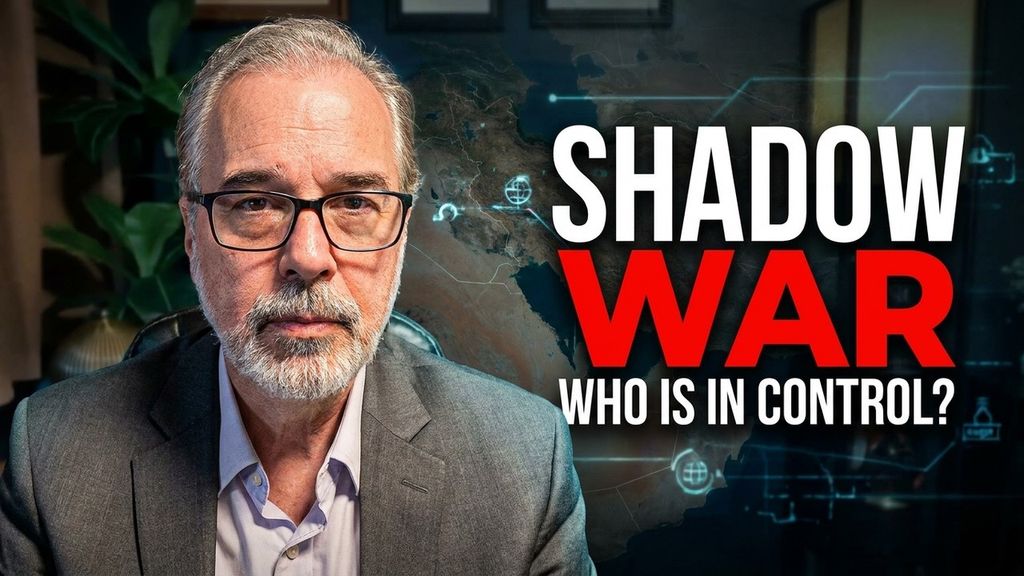
Richard Dolan Links Shadow War in the Persian Gulf to Systemic Loss of Control and Potential UFO Interest


Richard Dolan situates the recent events in the Persian Gulf within what he calls a shadow war, focusing first on a reported Iranian precision strike that destroyed a U.S. AWACS airborne warning and control aircraft. In his assessment, this was not an indiscriminate attack but a highly targeted operation against specific high‑value assets, implying access to detailed and timely intelligence on U.S. aircraft locations.
According to Dolan, the level of targeting accuracy points beyond Iran’s acknowledged missile and drone capabilities toward an external provider of real‑time intelligence and integrated surveillance. He argues that Russia is the most plausible candidate, with China as an alternative, given both capability and motive. He connects this to the ongoing conflict in Ukraine, where U.S. intelligence and targeting support have enabled Ukrainian strikes deep inside Russian territory. Russian leaders have repeatedly signaled they would respond in their own time, and Dolan frames assistance to Iran as a form of reciprocity within this broader contest.
The strike, in his view, also reveals vulnerabilities in U.S. preparedness. High‑value surveillance aircraft appear to have been left exposed without adequate hardening or dispersal, raising questions about whether U.S. planners are adapting effectively to a highly contested environment. Dolan challenges political rhetoric that portrays Iran as already neutralized, arguing instead that Iran is a large, internally stable nation with a functioning military, strong regional relationships, and increasingly close links to Russia and China. Under these conditions, any U.S. ground deployment or attempt to seize islands in the Strait would face high risk, with troop movements, staging areas, and logistics networks highly visible to adversary sensors and vulnerable to precision attack.
To illustrate how warfare has evolved, Dolan points to the role of drones and surveillance in Ukraine, where both Russian and Ukrainian forces learned that large arrow offensives invited catastrophic losses. He references Ukrainian operations in 2023 and the later Kursk offensive in 2025 as examples of major troop concentrations failing under continuous observation and guided munitions. He warns that if the United States attempts comparable large‑scale movements in the Gulf, the results are unlikely to be favorable, especially given constraints on how many troops can realistically be deployed to achieve significant change on the ground.
Beyond battlefield dynamics, Dolan emphasizes the broader systemic impact of Persian Gulf instability. Disruption in this region affects global oil markets, maritime transport, industrial output, fertilizer supplies, fuel prices, and thereby food systems and economic conditions across Europe, Asia, and other energy‑dependent economies. He describes the Gulf as a structural node within the global system, where local military actions propagate through interconnected economic and political networks. From this perspective, he argues, the current conflict is not an isolated regional confrontation but a component of a larger, high‑risk global configuration.
Within that structural view, Dolan introduces the question of UFO activity. Rather than simply asking whether there are UFOs over Iran, he suggests focusing on whether the conditions now present in the Persian Gulf match those under which UFOs have historically been reported with greater frequency. High tension, concentrated military force, significant escalation risk, and global consequences are, in his reading of the historical record, the environments where anomalous phenomena have often shown interest.
If UFO or USO activity is heightened in this shadow war, Dolan does not expect overt public displays or obvious intervention. Instead, he anticipates patterns consistent with past reports: objects operating near naval forces, in or near bodies of water, pacing ships or aircraft, or appearing around carrier groups that have shifted from the Gulf into the Arabian Sea or farther into the Indian Ocean. He raises the possibility of localized interference with radar or communications experienced by crews but never clearly presented to the public, either because such incidents remain classified or are filtered out by institutional processes.
At the same time, Dolan is careful to separate these possibilities from routine military events. He notes that the loss of an F‑35 in the region is most plausibly explained by Iranian air defenses rather than UFO involvement and warns against attributing every anomalous or unclear incident to non‑human causes. In his view, conventional explanations will usually apply, but the question of where one would expect anomalous activity to appear remains relevant. Based on decades of accounts, he identifies fleets, submarines, maritime choke points, missile environments, and dense air defense networks—exactly the types of environments now prominent in the Persian Gulf theater—as locations where reports have been most common.
From this operational and UAP‑related analysis, Dolan turns to the deeper issue of who is really in control of such complex situations. He argues that it is misleading to imagine modern conflict as a simple chain of command where presidents, prime ministers, or generals make decisions that are then cleanly implemented. Instead, he describes layered systems—military, political, economic, and informational—each with its own priorities and internal logic, all interacting under conditions of mounting pressure. As stress increases, decision cycles compress, information becomes incomplete or ambiguous, and actions in one part of the system trigger cascades elsewhere.
Under these circumstances, overall control does not vanish but becomes partial, reactive, and unstable. Dolan proposes that the institutions managing security and war usually begin as practical responses to real vulnerabilities: states lacking resources or feeling weak relative to neighbors construct military structures, intelligence networks, doctrines, and alliances as tools for survival. Over time, however, these tools can harden into ideologies that narrow decision‑makers’ perspectives and push societies toward outcomes no single actor fully intends.
He illustrates this with the historical case of Prussia and the unification of Germany in the late nineteenth century. Prussia’s military culture and institutions proved highly effective at defending and expanding German power, eventually shaping the ideology of unified Germany under Bismarck and the Kaiser. Yet the same militarism, national defense doctrine, and demand for cultural conformity contributed to the conditions leading to the First World War. By invoking this example, Dolan suggests that contemporary systems in the Persian Gulf and beyond may likewise have evolved from rational security measures into complex structures that now constrain leaders and generate outcomes beyond their full control.
Placed against this backdrop, the shadow war in the Persian Gulf, the possibility of external great‑power involvement, the risk of nuclear proliferation, and the potential presence of UFO activity near critical nodes of military force all merge into a single question: how much agency do human decision‑makers still exercise within the sprawling systems they have built? Dolan’s analysis implies that understanding modern conflict—and any anomalous phenomena that may be monitoring it—requires looking beyond individual leaders to the interacting networks of power, technology and information that shape events on the ground.
Key Moments
- 00:44Dolan describes a precise Iranian strike on a U.S. military installation that reportedly destroyed a high‑value AWACS airborne warning and control aircraft, emphasizing the unusual targeting accuracy involved.
- 02:01He argues that the quality of targeting suggests real‑time intelligence support and integrated surveillance, likely from an external actor such as Russia and possibly China.
- 02:34Dolan frames this as a form of reciprocity for extensive U.S. intelligence assistance to Ukraine, suggesting Russia may now be returning the favor by aiding Iran.
- 03:51The strike is presented as exposing gaps in U.S. preparedness, with high‑value aircraft left insufficiently hardened or dispersed in an increasingly contested environment.
- 05:09He characterizes Iran as a large, internally stable state with a functioning military, regional ties, and deepening connections to Russia and China, complicating any U.S. ground deployment in the Gulf.
- 06:05Drawing on Ukraine, Dolan highlights how drones and precision systems make large troop movements highly vulnerable, turning modern war into attritional conflict and limiting the feasibility of major offensives.
- 08:43He contends the Trump administration appears trapped in the Gulf crisis, with official statements of control and stability diverging sharply from observable events and escalating risks.
- 09:55Dolan stresses that disruption in the Persian Gulf affects oil markets, transportation, industrial production and food systems worldwide, making the region a structural node in the global system rather than just a military theater.
- 11:05He argues that the Persian Gulf fits the historical pattern of locations where UFO activity has clustered: high‑tension environments with concentrated military force and significant global consequences.
- 12:07Based on past reports, Dolan anticipates any increased UFO or USO activity would likely involve objects near naval forces, water, or carrier groups in the Arabian Sea and Indian Ocean, with possible radar or communications interference, and might not become public for years.
- 14:07He cautions against attributing routine military losses or maneuvers, such as an F‑35 shoot‑down, to UFOs, emphasizing that conventional explanations usually apply even if anomalous events might also occur in the same environment.
- 14:36Historically, Dolan notes, anomalous activity tends to appear near fleets, submarines, choke points, missile environments, and air defense systems where escalation risk is highest.
- 15:21He then shifts to the deeper issue of control, arguing that under pressure modern military, political, economic, and informational systems interact in complex ways that limit any single leader’s ability to direct events.
- 16:57In high‑stress conditions, decisions are compressed, information becomes incomplete or ambiguous, and chained reactions make overall situations increasingly difficult to grasp, turning control partial, reactive, and unstable.
- 18:36Using the example of Prussia and unified Germany, Dolan illustrates how institutions created as practical tools for security and power can, over time, narrow perspective and contribute to large‑scale conflicts such as the First World War.
Related Topics
Links & References
- Channel membership link for Richard Dolan Intelligent Disclosure, offering supporter tiers and exclusive content.
- Amazon author page for Richard M. Dolan, featuring his books on UFOs, UAP, and national security.
- Richard Dolan's member website providing exclusive lectures, articles, podcasts, and forums on UAP research.
- Official X (Twitter) account for Richard Dolan and Intelligent Disclosure updates.
- Facebook page for Intelligent Disclosure with news and commentary from Richard Dolan.
- Richard Dolan's Instagram account for additional media and announcements.
 Continue with Google